Apple Hit $5 Trillion Today. Polymarket's $9.8M in Bets Says NVIDIA Takes It Back by December — and Alphabet Is the 14% Dark Horse Nobody Is Talking About
July 28, 2026 · 17 min read
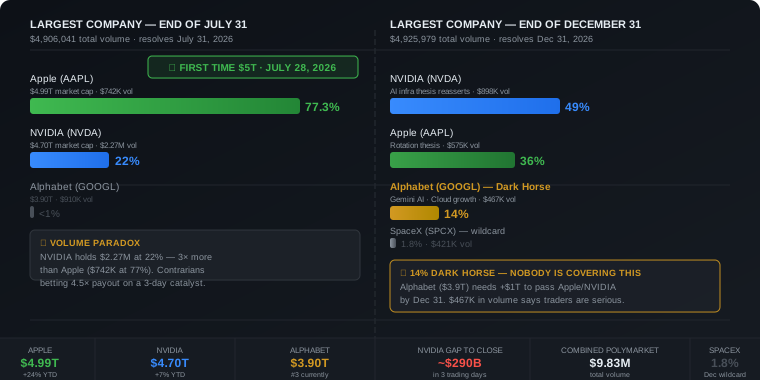
Apple's path to $5 trillion took longer than NVIDIA's and followed a different route. NVIDIA hit the milestone on October 29, 2025, on the back of data-centre GPU demand that had no historical precedent — $62.3 billion in revenue for a single quarter, 75% year-on-year growth, and a stock that tripled in eighteen months. Apple crossed $5 trillion today at an intraday high of $342.89 per share, up roughly 24% year-to-date and 60% over the past twelve months. The divergence in how each company got there explains why the same Polymarket market that prices Apple at 77.3% for July 31 has NVIDIA at 49% for December 31.
This is not a simple "who wins" story. There are two active markets on Polymarket tracking this question simultaneously, with a combined $9.83 million in trading volume and a resolution gap of five months between them. What happens between July 31 and December 31 is where the real analysis lives — and that is what every 650-word news article about Apple crossing $5 trillion is missing.
The July 31 Market: Apple 77.3%, NVIDIA 22%, Three Days Left
The "Largest Company end of July?" market on Polymarket resolves on July 31, 2026 at market close — three trading days from now. As of today, Apple trades near $340 per share, giving it a market cap of approximately $4.99 trillion. NVIDIA is at roughly $4.7 trillion. The gap is approximately $290 billion. Apple is the 77.3% favourite on Polymarket, with $742,700 in volume. NVIDIA holds 22%, with $2,272,219 in volume.
| Company | Polymarket Prob. | Volume | Est. Market Cap |
|---|---|---|---|
| Apple (AAPL) | 77.3% | $742,700 | ~$4.99T |
| NVIDIA (NVDA) | 22% | $2,272,219 | ~$4.70T |
| Alphabet (GOOGL) | <1% | $910,784 | ~$3.90T |
| Microsoft (MSFT) | <1% | $236,691 | — |
| Tesla (TSLA) | <1% | $219,136 | — |
| Amazon (AMZN) | <1% | $131,123 | — |
| Broadcom (AVGO) | <1% | $168,969 | — |
| Saudi Aramco | <1% | $231,724 | — |
The 22% on NVIDIA is not a rounding error. In percentage terms: at $290 billion behind with three trading days remaining, NVIDIA would need to gain approximately 6.2% relative to Apple to overtake before July 31. That has happened to individual large-cap stocks over a three-day window on dozens of occasions. What makes NVIDIA's 22% price defensible rather than irrational is the nature of what moves these stocks: a single piece of news — an earnings update, a hyperscaler customer announcement, a Blackwell yield improvement — can shift $300 billion in NVIDIA market cap within an hour.
The NVIDIA Volume Paradox: $2.27M on the 22% Side
The most instructive number in this market is not the probability. It is the volume distribution. Apple is the 77.3% favourite, yet it has only $742,700 in total trading volume. NVIDIA is the 22% underdog, yet it has $2,272,219 — more than three times the volume of the market leader.
This structure occurs in prediction markets when one of two conditions is true: either early-position traders who bought NVIDIA when it was the leader have not exited (their historical buys inflate the denominator even if no new NVIDIA buying is happening today), or there is genuine ongoing conviction on the NVIDIA side — traders building positions at 22% because they believe the fundamental case for NVIDIA has not changed and Apple's current lead is temporary rotation rather than structural re-rating.
The investment thesis for the 22% camp is clean: Apple's advance reflects a shift in investor sentiment away from AI capex intensity, not a change in AI semiconductor fundamentals. NVIDIA's data-centre revenue grew 75% year-on-year. No company in Apple's product portfolio generates anything comparable to Blackwell GPU orders. The premium investors are placing on Apple's "restrained capex" narrative is real but reversible — any sign that AI infrastructure spend is sustainable and growing, and NVIDIA's multiple expands again while Apple's rotation trade unwinds.
The 22% NVIDIA buyers are not wrong about the structural argument. They are making a bet that three days is long enough for that argument to become news.
The "2nd Largest" Market — The Other Data Point Most Coverage Misses
There is a second, less-discussed Polymarket market that provides a consistency check: "2nd Largest Company end of July?" resolving on the same date with $541,636 in volume. If Apple is 77.3% to be #1, you would expect NVIDIA to be roughly 77.3% to be #2 (since if Apple wins #1, NVIDIA would be #2 in almost every scenario). The market shows exactly this.
| Company | Prob. to Be #2 | Volume |
|---|---|---|
| NVIDIA | 72% | $185,080 |
| Apple | 24% | $144,595 |
| Alphabet | 2.3% | $153,381 |
NVIDIA at 72% for #2 is internally consistent with Apple at 77.3% for #1. If Apple holds, NVIDIA is almost certainly #2. Apple's 24% to be #2 is the probability that NVIDIA reclaims #1 — again consistent with NVIDIA's 22% in the primary market. Alphabet's 2.3% chance of being #2 says traders see near-zero probability of Alphabet passing either Apple or NVIDIA before July 31, even though at $3.9 trillion it is the third-largest company by a wide margin.
The December Market — Where the Real Story Lives
Five months is a different investment horizon than three days, and the "Largest Company end of December 2026?" market reflects that. NVIDIA leads at 49%. Apple is at 36%. And Alphabet has 14% — the most underreported number in the entire Apple/NVIDIA story right now.
| Company | Dec 31 Probability | Volume |
|---|---|---|
| NVIDIA | 49% | $898,340 |
| Apple | 36% | $575,060 |
| Alphabet | 14% | $467,811 |
| SpaceX (SPCX) | 1.8% | $421,458 |
| Microsoft | <1% | $631,606 |
| Saudi Aramco | <1% | $741,262 |
The shift from Apple 77% (July) to Apple 36% (December) is a 41-point collapse in five months. The shift from NVIDIA 22% (July) to NVIDIA 49% (December) is a 27-point recovery. These are not small movements. They represent a fundamental view among Polymarket traders that Apple's current lead is cyclical and NVIDIA's structural position in AI infrastructure reasserts itself over longer time horizons.
The basis for this view: Apple's $5 trillion crossing reflects portfolio rotation by investors who became concerned about AI capex sustainability. That rotation has a natural ceiling — once the valuation gap between "restrained AI spenders" and "aggressive AI spenders" re-prices fully, the rotation stops and fundamentals reassert themselves. NVIDIA's fundamentals include $62.3 billion in quarterly data-centre revenue. Apple's fundamentals include strong iPhone and services margins but no equivalent to Blackwell GPU demand. The December market says these fundamentals matter more over five months than they do over three days.
Alphabet at 14% — The Most Interesting Number in This Entire Market
Alphabet currently sits at approximately $3.9 trillion in market cap — roughly $1.1 trillion behind Apple. For Alphabet to be the #1 company by December 31, it needs to gain more than $1 trillion relative to whichever company leads at year-end. The 14% on Polymarket implies Alphabet does this more than one time in seven on the current trajectory.
What is the Alphabet thesis? Google's AI monetisation in 2026 has moved from promise to evidence. Gemini AI integrations across Google Search, Google Workspace, and Google Cloud are generating measurable revenue increments. YouTube's advertising yield has improved as AI-powered targeting tightens. Google Cloud's market share in enterprise AI workloads is growing faster than Azure and AWS in several benchmark categories. Alphabet has also avoided the "AI spending backlash" narrative that has suppressed NVIDIA's stock in July — not because it is spending less (it is not), but because its AI spending goes directly into product differentiation rather than customer financing.
The $467,811 in trading volume on the Alphabet December leg — the third-highest of any company in the market — tells you that traders are taking this seriously. At 14%, the expected payoff on a correct Alphabet call is approximately $7 per $1 staked. That kind of asymmetric return attracts sophisticated volume even when the base case says it is unlikely.
The counter-argument: for Alphabet to pass Apple and NVIDIA, you need both of those companies to underperform, not just Alphabet to outperform. A three-way scenario where Alphabet rises 30%, Apple falls 10%, and NVIDIA stays flat is plausible but requires a specific macro environment that does not currently look like the base case. The 14% is not a prediction that this happens. It is a price on the probability, and at 14%, the market is saying it happens one time in seven.
SpaceX at 1.8% — The Wildcard That $421K of Volume Won't Let You Ignore
SpaceX (SPCX) is priced at 1.8% to be the world's largest company by December 31 — with $421,458 in trading volume behind that 1.8%. The implied expected value for a correct SpaceX prediction at these odds is approximately $55 per dollar staked. SpaceX went public on June 12, 2026 at $135 per share, hit $225 on June 16, crashed to $119 on July 20 after two Starship aborts, and currently trades near $123 — a market cap of approximately $1.56 trillion. To reach #1, SpaceX would need to roughly triple from here by December while Apple and NVIDIA simultaneously fall.
The $421K on SpaceX at 1.8% is not irrational speculation. It is a lottery ticket with known payoff structure. The scenario that resolves it YES — a successful Starship flight programme, a major commercial contract, and a significant re-rating of the satellite-to-orbit business — is low-probability but structurally coherent. The volume tells you some traders believe the 1.8% underestimates the option value of Starship's upcoming flight programme.
Three Scenarios for the Rest of 2026
Scenario A (77% for July, then NVIDIA recovery): Apple holds #1 through July 31, confirming the rotation trade. Over the following five months, NVIDIA's AI infrastructure thesis reasserts. Data-centre revenue beats consensus in August. Blackwell yield improves. Apple's stock consolidates after the $5T milestone as the rotation trade has nowhere new to go. NVIDIA reclaims #1 by September-October and holds it through December. Polymarket's December market pays out at 49% NVIDIA. This is the base case.
Scenario B (22% for July): NVIDIA delivers a catalyst in the next three trading days — most likely earnings-adjacent guidance or a customer announcement — closes the $290B gap, and reclaims #1 before July 31. Apple finishes July at #2. This validates the NVIDIA thesis early, and the December market's 49% NVIDIA looks conservative in retrospect. The $2.27M in July NVIDIA volume pays out at approximately 4.5x.
Scenario C (14% Alphabet dark horse): Neither Apple nor NVIDIA consolidates their lead cleanly. A broader tech rotation into quality compounders with diversified AI revenue picks Alphabet over pure-play AI hardware and consumer hardware. Alphabet reaches or approaches $5T before December 31, overtaking whichever of Apple/NVIDIA holds the lead at that point. This is the lowest-probability scenario but the one with the highest absolute payoff. The $467K at 14% is concentrated smart money saying this scenario exists.
How to Think About Trading These Markets
The July 31 market at Apple 77.3% offers roughly 30% ROI if Apple holds — three days, three trading sessions, for a 30-cent-on-the-dollar return. That is an annualised rate that attracts capital. The risk is a single large NVIDIA catalyst in a concentrated window. At current prices, selling NO on Apple (i.e. buying YES on "Apple is NOT #1 by July 31") would cost approximately 22.7 cents per dollar of exposure and pay $1 if NVIDIA reclaims — roughly 4.4x return. That asymmetry explains the NVIDIA volume.
The December market is more balanced. NVIDIA 49%, Apple 36%, Alphabet 14%, SpaceX 1.8%. No single outcome has the certainty of the July market. The most interesting position in this market — from a risk-adjusted expected value perspective — is the Alphabet leg. At 14% with five months of time value, a position on Alphabet benefits from any news that re-rates the AI monetisation story broadly rather than just the AI hardware story.
One important mechanic: these are two separate Polymarket markets, not correlated. A position on Apple to win July does not pay out if Apple wins December, and vice versa. Traders who want to express a view on "Apple vs NVIDIA over the whole year" need to hold positions in both markets independently, sized to their conviction on each timeframe.
Frequently Asked Questions
What are the Polymarket odds for Apple vs NVIDIA as the world's largest company?
As of July 28, 2026: Apple 77.3% vs NVIDIA 22% to end July 31 as #1 (total volume: $4.9M). For December 31: NVIDIA 49% vs Apple 36% vs Alphabet 14% (total volume: $4.9M). Combined across both markets: $9.83M.
Did Apple reach a $5 trillion market cap?
Yes — briefly today (July 28, 2026). Apple hit an intraday high of $342.89 per share, making it only the second company in history to reach $5 trillion, after NVIDIA crossed that mark first on October 29, 2025. By mid-afternoon Apple traded near $339.85, market cap ~$4.99T. The stock is up 24% year-to-date and 60% over the past 12 months.
Why is NVIDIA still at 22% on Polymarket with only 3 days left?
Apple leads NVIDIA by approximately $290 billion in market cap. A 6% move relative to Apple over three trading days is within the range of normal volatility for a mega-cap stock following a catalyst. The 22% reflects the probability of such a catalyst appearing — not the assumption that NVIDIA can close the gap through organic drift alone.
Why does NVIDIA have more Polymarket trading volume than Apple?
NVIDIA has $2.27M in volume at 22% vs Apple's $742K at 77.3%. This is the "favourite-longshot" paradox in reverse: traders building the contrarian NVIDIA position do so in larger size because the payoff is 4.5x. Apple's holders are already winning and don't need to add. Additionally, early positions placed when NVIDIA led contribute to its historical volume total.
Why is Alphabet at 14% for largest company by December 2026?
At ~$3.9T, Alphabet needs to gain roughly $1T relative to both Apple and NVIDIA to reach #1 by December 31. The 14% reflects trader belief in Alphabet's AI monetisation trajectory — Gemini integrations across Search, Cloud, and Workspace — and the possibility of a broader tech rotation away from pure-play AI hardware into diversified AI revenue generators. $467,811 in volume confirms this is not a fringe position.
What is SpaceX's probability of being #1 by December 2026?
1.8% YES with $421,458 in volume. At $1.56T current market cap (SPCX: ~$123/share after the Starship abort drama), SpaceX would need to roughly triple while surpassing Apple and NVIDIA simultaneously. The 1.8% is a lottery-ticket position — structurally coherent if Starship delivers multiple successful missions and commercial contracts materialise, but not the base case.