Polymarket Is Raising $1B at $20 Billion Today. Here's Why the World's Biggest Prediction Market Is Priced at Half Its Rival.
August 4, 2026 · 16 min read
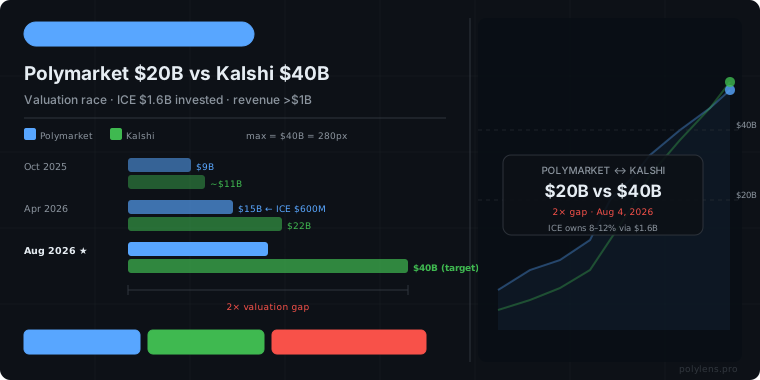
The platform with higher lifetime trading volume is raising at half the valuation of the platform with lower volume. If you follow prediction markets, this is the number that should stop you. Polymarket ran the World Cup market to $4.27 billion — the largest single prediction market contract in history. It hit $26.17 billion in Q1 2026. It launched a US exchange in May and crossed $1 billion in annualized revenue within six weeks. And today it is seeking a $20 billion valuation while Kalshi targets $40 billion.
The gap is not a mistake in the market's judgment. It reflects three specific structural factors that have nothing to do with Polymarket's product quality or user engagement. Understanding them tells you more about where prediction markets are heading than any volume chart.
Three Rounds in Ten Months: The $9B → $15B → $20B Staircase
Polymarket's valuation trajectory has been steep. In October 2025, ICE invested $1 billion in Polymarket at a $9 billion valuation — the NYSE owner's first direct prediction market bet. In March 2026, ICE added another $600 million in a round that brought in hedge fund D.E. Shaw and venture capital firm G Squared, bringing the valuation to $15 billion. Today's $20 billion target represents a 33% increase in four months.
| Round | Date | Polymarket Val. | Kalshi Val. | Key Investor |
|---|---|---|---|---|
| Series D / ICE round 1 | Oct 2025 | $9B | ~$11B | ICE ($1B) |
| Series E / ICE round 2 | Apr 2026 | $15B | $22B | ICE ($600M), D.E. Shaw, G Squared |
| Series F (in talks) | Aug 4, 2026 | $20B+ | $40B (target) | TBD (~$1B raise) |
| Gap at each stage | — | $2B → $7B → $20B widening | — | |
The valuation gap is widening, not closing. In October 2025, Kalshi was valued at roughly $2 billion more than Polymarket. By August 2026, that gap is $20 billion. Both companies have grown, but the market's assessment of the regulatory premium Kalshi carries has expanded faster than Polymarket's revenue growth has closed it.
One number gives context: ICE's total investment in Polymarket is approximately $1.6 billion. If Polymarket is now worth $20 billion, ICE's stake — somewhere between 8-12% depending on dilution — is worth $1.6-2.4 billion. ICE has already roughly recovered its capital on paper, and the position becomes significantly more valuable at the $20 billion mark they are now seeking. This round is not ICE's crisis — it is their confirmation.
Kalshi Passed Polymarket in Monthly Volume. That Just Happened.
In Q1 2026, Polymarket's monthly volume peaked at $10.5 billion, with $26.17 billion traded across the quarter — driven by FIFA World Cup betting that reached $4.27 billion on the winner market alone. Kalshi's volume in the same period was lower. Polymarket was the undisputed volume leader.
That changed in June 2026. Kalshi's monthly volume hit $21.1 billion. Polymarket's was $9.7 billion. The flip happened because the World Cup ended and the dominant category shifted from sports (Polymarket's global strength) to US political markets, where Kalshi's home-field advantage becomes decisive.
| Period | Polymarket Volume | Kalshi Volume | Leader | Driver |
|---|---|---|---|---|
| Q1 2026 (peak) | $26.17B | Lower | Polymarket | World Cup, crypto, US election run-up |
| May 2026 | $8.9B | ~$14B | Kalshi | Post-WC dip / US political ramp |
| June 2026 | $9.7B | $21.1B | Kalshi | Midterm markets, US domestic politics |
| Combined 2026 YTD | Kalshi + Polymarket >$130B total | — | Entire sector expanding | |
The June volume flip matters for the valuation story because it shows Kalshi's structural edge in US political markets — precisely the category that will dominate volume through November's midterms. Polymarket's US exchange launched in May, grew daily volume from $50 million to over $200 million by June 20, and reached $1.77 billion in monthly US volume by end of May. But the US arm represents roughly 20% of Polymarket's global volume — meaning 80% of their trades still flow through a platform geofenced from Americans.
Kalshi runs that math differently. Nearly 90% of its volume comes from US users, and every midterm Senate race, every congressional control market, every Fed rate decision is squarely in the regulatory frame it was built for. The midterms this November are Polymarket's opportunity to demonstrate that its US exchange can compete on home turf. Kalshi is betting the investors pricing it at $40 billion believe it wins that fight regardless.
What $20B vs $40B Actually Measures: P/S Ratios and the IPO Premium
Looking at price-to-revenue multiples strips out the narrative and shows the underlying valuation logic. Polymarket at $20 billion with $1 billion-plus in annualized revenue implies a P/S ratio of approximately 20x. ICE itself — the NYSE parent — trades publicly at roughly 20-25x trailing revenue. At 20x, Polymarket is priced like a mid-size financial exchange, not a crypto startup. That is what ICE's investment has done to the company's comparable set.
| Company | Valuation | Annualized Revenue | P/S Ratio | Category |
|---|---|---|---|---|
| Polymarket | $20B+ | >$1B | ~20x | Crypto prediction market |
| Kalshi | $40B (target) | ~$850M | ~47x | CFTC-regulated exchange |
| ICE (NYSE parent) | ~$90B (public) | ~$9B | ~25x | Financial exchange (public) |
| CME Group | ~$80B (public) | ~$6B | ~27x | Derivatives exchange (public) |
Kalshi at 47x is the number that requires explanation. Regulated financial exchanges do not typically trade at 47x revenue — ICE and CME are in the 20-27x range. But Kalshi is not priced like a current exchange; it is priced like a pre-IPO exchange where investors are pricing in a public market re-rating. Kalshi's management has acknowledged preparing for a 2027 IPO. When you buy Kalshi at $40 billion today, you are betting that the public market will value it at $60-80 billion post-IPO — a further 50-100% premium for liquidity and index inclusion that private investors capture at the pre-IPO stage.
Polymarket's 20x is constrained by the crypto discount. Institutional capital that would pay 40x for a regulated US exchange will not pay the same multiple for a crypto-native platform with pending regulatory questions, geofencing risk, and an active insider trading investigation. The $20 billion number reflects Polymarket's real business; the $40 billion number reflects Kalshi's exit strategy.
The Regulatory Gap: Why Crypto Rails Cost ~$20 Billion
Polymarket's main platform runs on Polygon, settles in USDC, and requires users to connect a crypto wallet. None of that is illegal — but it restricts the platform to the subset of people comfortable with crypto-native infrastructure, and it keeps the main platform geofenced from US users under CFTC regulatory uncertainty. The US exchange launched in May 2026 runs on traditional rails and can serve American retail traders, but the onboarding friction of two parallel platforms is real and the US arm's 20% volume share reflects it.
The insider trading investigation adds a specific risk premium. Between January and June 2026, Polymarket flagged $200 million in suspicious trading volume across approximately 34,000 trades, referring nearly 100 wallets to authorities. The highest-profile case: a newly created account placed a $32,000 bet on Nicolás Maduro's removal hours before US forces seized him, earning over $430,000 in profit. Israeli authorities charged two individuals with using classified military intelligence to trade Iran war markets on Polymarket. Bloomberg characterized the platform's challenge in August 2026 as "grappling with a new era of insider traders."
This is not a problem Polymarket can engineer away — geopolitical prediction markets are inherently attractive to people with information advantages. It is a cost of doing business at scale in this category. For investors pricing the $20 billion round, each $200 million in flagged trades is a potential regulatory liability that Kalshi — operating inside the CFTC's supervised framework — does not carry to the same degree. The regulatory discount is not a judgment on Polymarket's operations; it is an insurance premium that the market is pricing into the equity.
ICE's $1.6B Is a Data Bet — and That Changes Everything
The most underreported aspect of Polymarket's funding structure is what ICE is actually buying. Intercontinental Exchange owns the New York Stock Exchange, major commodity futures markets, the LSEG fixed income indices, and a $25 billion financial data business. When ICE buys $1.6 billion of Polymarket, it is not acquiring a gambling platform — it is acquiring a real-time probability engine for financial markets.
Consider what a major bank's trading desk does with Polymarket data: it reads the implied probability of a Fed rate decision, a geopolitical event, a company's earnings outcome, or an election result as a market-clearing number that aggregates global informed opinion in real time. ICE's existing data business sells this type of intelligence — corporate bond pricing, equity volatility surfaces, commodity forward curves — to institutional clients for billions of dollars annually. Polymarket adds a dimension that no existing financial data vendor provides: continuous real-money probability markets across a vastly wider event space.
CEO Shayne Coplan has explicitly framed this: Polymarket is an "information market," not a betting venue. The semantic shift is commercially important. A betting venue is regulated as a gambling operator. An information market operated as financial infrastructure is regulated as an exchange — and exchanges command 20-47x revenue multiples from institutional investors. ICE's $1.6 billion is not a bet that Polymarket becomes a better DraftKings. It is a bet that Polymarket becomes a Bloomberg terminal feed for event risk.
The Midterms Are the Next Test — and Kalshi Has Home-Field Advantage
The November 2026 midterms will be the next volume event that clarifies the competitive picture. Political markets are Polymarket's weakest relative position: Kalshi holds roughly 90% of the US political prediction market share, and midterm Congressional control markets have historically been the highest-volume domestic political event outside a presidential year.
Polymarket's US exchange is already active in political markets — 602 active midterm markets as of early August, with $20.7 million in current trading volume. That number will grow substantially as November approaches. The question is whether Polymarket's US exchange can convert its global liquidity advantage into US political market share before the midterm cycle peaks.
If Polymarket's US political volume reaches $1-2 billion by November — comparable to a strong quarter of Kalshi's current run rate — the gap between the two platforms narrows in the category that investors are pricing at a premium. If Kalshi remains the dominant midterm market and its monthly volume stays 2× Polymarket's through Q3, the $40 billion target becomes easier to defend and Polymarket's $20 billion looks like the floor rather than the ceiling.
The margin trading approval Polymarket sought from regulators in July 2026 is the other lever. Margin in prediction markets does for volume what options did for equity markets — it amplifies position sizing without requiring proportional capital increases. If approved for US users, it could shift the volume math on political markets significantly before the midterm cycle closes.
Polymarket at $20B and What It Is Not Saying
The $20 billion number is not Polymarket's ceiling. It is the price at which this round closes, for this pool of investors, at this moment. The $9B → $15B → $20B progression shows a company doubling in value in ten months while simultaneously launching a US product, crossing $1 billion in revenue, and running the largest sports prediction market in history. The trajectory is not the problem.
What the $40 billion Kalshi target is saying — and what the $20 billion Polymarket target is acknowledging — is that regulatory infrastructure, not trading volume, determines the terminal value of a prediction market exchange. Kalshi built for US regulation from day one. Its $40 billion is the market's estimate of what that regulatory footprint is worth as these platforms move from niche crypto products to mainstream financial infrastructure.
Polymarket is catching up. The US exchange, the ICE backing, the revenue trajectory, and the "information market" reframe are all moves toward the same destination. The $20 billion round buys the runway to get there. Whether the gap closes depends on whether Polymarket's US volume in Q3 and Q4 — the midterm cycle — demonstrates that the crypto-native platform can compete inside the regulatory perimeter that Kalshi owns.
That answer comes in November. Watch the midterm market volume numbers — they are the real funding round.
- Polymarket vs Kalshi: Fees, Markets, Regulation and Where Each Platform Wins
- Polymarket's $4.3B World Cup Accuracy Breakdown — The Record Market That Funded This Valuation
- Whale Tracking on Polymarket: How Large Positions Move Prices
- SpaceX IPO Polymarket Odds: $88B Market Cap, 1.8% for World's Largest Company
- How to Make Money on Polymarket: Strategy, Signals, and Edge Sources