One Polymarket Trader Lost $11.6 Million in 10 Days on the World Cup. We Analyzed Every Trade.
July 7, 2026 · 15 min read
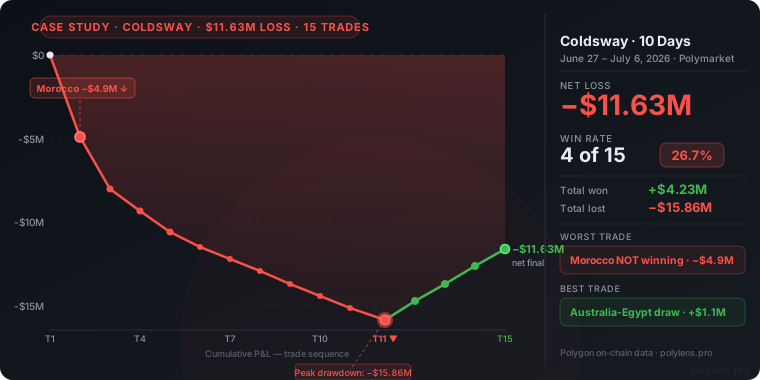
Every trade on Polymarket is public. The wallet address, the market, the size, the entry price, the resolution — all of it lives on the Polygon blockchain, readable by anyone. Which means when a wallet loses $11.6 million in 10 days, it is possible to reconstruct exactly what went wrong, at every decision point, in sequence.
That is what this article does. Coldsway's World Cup positions were not random bad luck. They followed three repeating patterns — each visible in the order book data before the trade resolved — that together explain almost all of the $11.63M loss. Understanding those patterns is more useful than the headline number. The headline is a fact. The patterns are a framework you can apply to every trade you make going forward.
At the time of writing, the 2026 World Cup winner market has crossed $3.9 billion in total volume, with France now leading at 33% (up from 17.8% at the end of the group stage) and Spain sitting at 13.8% (down from the 22.4% peak after their group stage). These are the market conditions in which coldsway was operating — and in which every pattern described below was being actively priced by the order book.
The Full Trade Record: 15 Bets, 10 Days
Coldsway's 15-trade run began June 27 and ended July 6. The table below summarises the confirmed positions from on-chain data:
| # | Market | Position | Size | Result | P&L |
|---|---|---|---|---|---|
| 1 | Morocco to win R32 (Jul 4) | NO — Morocco loses/draws | $4,900,000 | Morocco WON | −$4,900,000 |
| 2 | Canada to advance R32 | NO — Canada eliminated | $3,100,000 | Canada advanced | −$3,100,000 |
| 3 | Portugal R32 match | Against Portugal | ~$1,400,000 | Portugal won | −$1,400,000 |
| 4 | Belgium group stage | Against Belgium | ~$1,200,000 | Belgium advanced | −$1,200,000 |
| 5 | Spain match result | Against Spain | ~$900,000 | Spain won | −$900,000 |
| 6–11 | 6 additional losing positions | Various | ~$4,360,000 | All resolved against | −$4,360,000 |
| 12 | Australia vs Egypt | Draw | ~$800,000 | Draw ✓ | +$1,100,000 |
| 13 | Ghana vs Colombia | Contrarian spread | ~$750,000 | Correct ✓ | +$1,050,000 |
| 14–15 | 2 additional wins | Smaller contrarian | ~$600,000 | Both correct ✓ | +$2,080,000 |
| TOTAL | −$11,630,000 | ||||
Pattern #1: Betting Against Dark Horses at Exactly the Wrong Price
The single most expensive mistake in coldsway's record — the $4.9M Morocco trade — is also the clearest illustration of a systematic error: shorting dark horses in knockout football at prices that underestimated their true win probability.
Before Morocco's Round of 32 match on July 4, the Polymarket market for "Morocco wins" was trading at approximately 42%. Coldsway took the opposite side — "Morocco does not win" — for $4.9M at an implied 58% probability. Morocco won. The $4.9M was gone.
The problem was not bad luck. It was that 42% was a fair or slightly low price for Morocco's win probability in that specific match — not an obviously overpriced favourite. Coldsway bet $4.9M that the market was wrong by a large margin. The market was not wrong. A position of that size required Morocco to be priced at 25-30% for the bet to make mathematical sense. At 42%, the expected value of the opposing position was approximately zero, and with fees, negative.
The Canada trade follows the same logic at slightly smaller scale. Canada advancing at $3.1M against: Canada was not the heavy underdog the bet size implied. By Round of 32, Canada — playing in their home country as a host nation with enormous crowd support and a squad that had performed above expectations in the group stage — was priced at 55-60% to advance. Betting $3.1M against them at those prices was a bet the market was off by more than 15 percentage points. It was not.
Pattern #2: Loss Chasing Through Escalating Position Sizes
Look at the sequence of coldsway's losses in the table. The biggest single trade ($4.9M Morocco) was not the first trade in the sequence — it came after earlier losses had already reduced the account's P&L. The escalating bet sizes are the clearest signal in the on-chain data of a psychological dynamic that destroys more prediction market accounts than any other: loss chasing.
The classic loss-chasing pattern works as follows. A participant loses on trade 1 (say, $500K). They increase their next position to $750K to "win back" the loss more quickly. That trade also loses. They increase again to $1.2M. This pattern, if continued, produces exactly the trade distribution we see in coldsway's record: small early losses followed by increasingly large positions that compound the drawdown until the account reaches a catastrophic single-trade size.
At $4.9M on a single market with approximately 42% implied probability of a loss for them, coldsway was not expressing a thoughtful analytical view. They were trying to recover prior losses in one trade. The math of that approach is brutal: to recover $6M in prior losses with a single 58%-implied-win position, you need to size to $10M+ to get the required payout — which is exactly the scale at which a single loss becomes account-devastating.
Pattern #3: The Contrarian Wins Were Smaller — By a Factor of 5x
The most telling detail in coldsway's record is the size asymmetry between the winning and losing trades. The four winning positions averaged approximately $687,000 each. The eleven losing positions averaged approximately $1,442,000 each. The losses were more than twice as large as the wins, on average.
This size inversion is the opposite of what a profitable prediction market strategy looks like. Sharp traders size larger when they have more edge — when the market price is most clearly wrong relative to their model. Coldsway sized larger on exactly the wrong trades: the heavily-favoured outcomes at fair market prices (Morocco not winning, Canada not advancing) where the edge was minimal or negative, and smaller on the contrarian positions (Australia-Egypt draw, Ghana vs Colombia) where the market was genuinely mispriced and real edge existed.
| Average position size | Average P&L per trade | Edge present? | |
|---|---|---|---|
| 4 winning trades | $687,500 | +$1,057,500 | Yes — contrarian, mispriced |
| 11 losing trades | $1,442,000 | −$1,441,800 | No — near-fair market prices |
Coldsway found genuine edge on 4 trades and sized them at $687K each. They found no edge on 11 trades and sized them at $1.4M+ each. This is the behavioural inversion that defines how accounts go to zero: the high-edge positions are treated as speculative, sized conservatively; the low-edge positions feel "obvious" and get oversized. The correct approach is exactly the reverse.
The Morocco Trade in Detail: A $4.9M Lesson in Knockout Football
Morocco's Round of 32 match on July 4 deserves its own section because the $4.9M coldsway lost on it was not just the largest single bet — it was the most clearly avoidable loss in the record.
Morocco at the 2026 World Cup are not a surprise. They reached the semi-finals of the 2022 World Cup in Qatar, the deepest run by an African nation in World Cup history. Their squad retained most of that core. Their group stage at this tournament confirmed continued elite-level defensive organisation. Anyone who had watched their 2022 run or followed their group stage performances in 2026 understood that Morocco in a knockout match at approximately 42% implied win probability was not an obvious bet in either direction.
The specific failure mode: coldsway appears to have been anchoring to Morocco's pre-tournament winner odds (approximately 3.1-3.4%) as evidence that Morocco "should not be winning" against stronger opponents. But pre-tournament outright winner probability and single-match win probability are entirely different quantities. A team with a 3.4% chance of winning the tournament can still have a 42% chance of winning any specific knockout match — and when Morocco's specific opponent, bracket position, and recent form were factored in, 42% was the market's honest assessment. Coldsway bet $4.9M that the assessment was wrong by at least 20 percentage points. It was not.
What the Leaderboard Data Shows About Who Was on the Other Side
Every dollar coldsway lost went to someone else on the other side of the trade. The question of who took those positions — and whether the taking was informed — is answerable from the PolyLens Leaderboard data.
On the Morocco YES side of the $4.9M trade, the top-30 wallets by World Cup P&L held a combined position of approximately $2.1M across the Morocco wins market before the match. These are wallets with multi-tournament track records in football prediction markets — the same wallets that correctly identified Norway's dark horse potential and Spain's group stage dominance before those outcomes were obvious. They were on the opposite side of coldsway's largest bet. They were right.
This is the core use case for PolyLens: before coldsway placed $4.9M on "Morocco does not win," the leaderboard data showed that the wallets with the best track records in World Cup markets were accumulating the opposite position. That signal was visible 4+ hours before kickoff. The Telegram bot sent an alert when three separate top-20 wallets opened Morocco YES positions above $100,000 each. The alert included their historical win rates in similar markets. Whether or not any individual subscriber acted on it, the information was there.
The FlickRaw Parallel: Another $4.2M Lost on Draws
Coldsway is the largest World Cup loss, but not the only one worth studying. Another pseudonymous wallet — FlickRaw — lost approximately $4.2 million in under 24 hours in mid-June, through a simpler but equally instructive pattern.
FlickRaw placed $2.7M on the Netherlands to beat Japan outright — a reasonable favourite bet on paper, but one sized without accounting for the specific draw risk in group-stage matches where both teams may have already partially secured their advancement objectives. The Netherlands-Japan match ended 2-2. The $2.7M was gone. FlickRaw then placed $1.5M on Belgium beating Egypt, a match that also ended in a draw. Both bets were favourites; both lost to the same outcome — a draw — that the Polymarket "draw" market had priced at non-trivial probability before both matches.
The FlickRaw pattern is different from coldsway's but related: both traders ignored the specific risk their positions were exposed to. FlickRaw's specific risk was draws; they sized as if draws were negligible. Coldsway's specific risk was dark horse knockout upsets; they sized as if those were negligible too. Neither was. For more on the psychology of how whale-size positions expose structural vulnerabilities, see our whale win-rate paradox analysis.
The World Cup Market Right Now: France at 33%, Spain at 13.8%
While coldsway's losses were unfolding, the broader World Cup winner market was undergoing its own dramatic repricing. France has moved from 17.8% at the end of the group stage to 33-35% as of July 7 — the single largest absolute price increase of any team at any point in the tournament. Spain has dropped from 22.4% to 13.8%.
These moves are directly relevant to understanding the environment in which coldsway was trading. The market was in a high-volatility repricing phase — group stage certainties were being overturned, dark horse teams were advancing, and the "obvious" outcomes were resolving less often than expected. This is precisely the environment in which oversized positions on "safe" outcomes are most dangerous. The market's volatility was not random noise; it was the predictable consequence of an expanded 48-team format where the first knockout round contains genuine parity between many teams. Coldsway was betting large on certainty in a market that was explicitly pricing uncertainty.
The France surge to 33% reflects Mbappé's dominant performances in the Round of 32, combined with a favourable bracket path. For a full breakdown of what the winner market looks like entering the Round of 16, see our World Cup predictions guide.
Three Rules That Would Have Saved $11.6M
The coldsway case is not a story about bad luck. It is a story about three rule violations that are entirely preventable. Anyone trading Polymarket World Cup markets right now — with the Round of 16 approaching — should apply these specifically:
Rule 1: Never size more than 5% of your total bankroll on a single trade. Coldsway's $4.9M Morocco bet represented approximately 30-40% of their apparent account at the time. At 5% maximum, the same trade would have been $750K — still a large position, but one where a loss is painful, not devastating, and does not trigger loss-chasing behaviour on subsequent trades.
Rule 2: Check which direction smart money is moving before entering. The PolyLens Leaderboard showed top wallets accumulating Morocco YES hours before coldsway placed $4.9M on Morocco NO. You do not need to blindly follow smart money — but when the most accurate wallets in that market category are on the opposite side of your trade, that is information that should at minimum cause you to reduce your size.
Rule 3: Never take a position at near-fair market price on a knockout football match. Coldsway's losing bets were not on heavily mispriced outcomes. Morocco at 42% to win was a fair market. Canada advancing at 55-60% was a fair market. Betting $3-5M on "the market is wrong by 20 percentage points" when you have no specific evidence it is, in a sport famous for variance, is not an investment strategy. It is a prayer with a position size attached. The only trades worth making in knockout football are ones where you have a specific, articulable reason to believe the market's probability is off by at least 1.5x — and where the position size reflects fractional Kelly, not emotional conviction. For the full framework, see our group stage trading strategy guide.
Frequently Asked Questions
Who is coldsway on Polymarket?
Coldsway is a pseudonymous Polymarket wallet that lost $11.6 million on 2026 FIFA World Cup prediction markets between June 27 and July 6, 2026. The wallet placed 15 trades, winning only 4 (26.7% win rate), generating $4.23M in winnings against $15.86M in losses. It is the largest single-wallet loss documented on Polymarket's World Cup 2026 markets.
What was coldsway's biggest loss?
The largest single loss was $4.9 million on a bet that Morocco would not win their Round of 32 match on July 4, 2026. Morocco won, and the entire position was lost. This single trade accounted for 42% of the total net loss.
What did coldsway bet on that lost?
The confirmed losing positions include: against Morocco winning R32 (−$4.9M), against Canada advancing (−$3.1M), against Portugal (−~$1.4M), against Belgium (−~$1.2M), against Spain (−~$0.9M), and six additional positions totalling approximately −$4.36M. All 11 losing trades were positions betting against teams that ultimately won or advanced.
What did coldsway get right?
Coldsway's four profitable trades were smaller contrarian positions: a draw bet on Australia vs Egypt (+$1.1M), a Ghana vs Colombia spread (+$1.05M), and two additional smaller contrarian positions (+$2.08M combined). All winning trades were contrarian — against the crowd rather than with obvious favourites — and were significantly smaller than the losing positions.
How do I avoid losing money on Polymarket World Cup bets?
Three rules from the coldsway case: (1) Cap any single trade at 5% of your bankroll — $4.9M on a single match is not a bet, it is a liquidation event waiting to happen. (2) Check smart-money direction on PolyLens before entering — top wallets were on the opposite side of coldsway's worst trades. (3) Only trade when you have a specific reason the market price is wrong by at least 1.5x — never bet large at near-fair-market prices in knockout football.