The Fed Was Supposed to Cut Rates Three Times in 2026. Polymarket's $40M Market Now Prices a 64% Chance of a Hike Instead — The Complete Reversal, Mapped.
August 13, 2026 · 12 min read
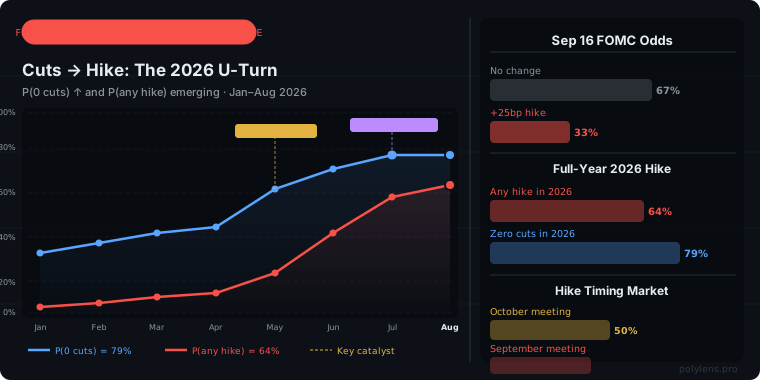
Entering 2026, every major investment bank consensus called for two to three Federal Reserve rate cuts by year-end. Prediction markets agreed: Polymarket's "How many Fed rate cuts in 2026?" market opened January with zero cuts at just 30% probability. Three cuts were overwhelmingly expected.
As of August 13, 2026 — one day after the latest CPI release — the same market prices zero cuts at 79%. And a completely separate market, "Fed rate hike in 2026?", now prices the hike side at 64%. The September 16 FOMC meeting carries 33% odds of a 25-basis-point rate increase.
In eight months, the market has moved from pricing aggressive easing to pricing a tightening cycle resumption. This is the most dramatic Fed U-turn priced by prediction markets in a decade — and $40.8 million in real capital sits behind these numbers.
| Metric | January 2026 | August 13, 2026 | Change |
|---|---|---|---|
| P(zero cuts in 2026) | 30% | 79% | +49pp |
| P(1+ rate hike in 2026) | ~3% | 64% | +61pp |
| P(Sep 16 hike) | n/a | 33% | — |
| Fed funds rate | 3.50%–3.75% | 3.50%–3.75% | unchanged |
| Total volume (rate cut market) | $4.1M | $40.8M | +10× |
January 2026: The Consensus That Turned Out to Be Wrong
The January 2026 consensus rested on three assumptions: inflation would continue falling toward 2%, the labor market would soften enough to justify easing, and new Fed Chair Kevin Warsh — who replaced Jerome Powell in February — would inherit a clean path to cuts.
All three broke down. Inflation, which had reached 2.7% in late 2025, reversed course. The labor market remained resilient. And Warsh, a known hawk who dissented in favor of tighter policy during his earlier Fed tenure (2006–2011), signaled from day one that he had no intention of cutting rates without sustained progress toward 2% CPI.
Polymarket's market absorbed this information faster than Wall Street's official forecasts. The "0 cuts" probability, which stood at 30% in January, had climbed to 43% by mid-April — before the first major inflation shock had even fully registered in consensus forecasts. This is prediction markets doing what they do best: aggregating dispersed information faster than institutional research cycles allow.
May's 4.1% CPI: The Moment the Cut Consensus Died
The pivot point arrived on May 14, 2026, when the Bureau of Labor Statistics reported April CPI at 4.1% — the highest reading since early 2023, and nearly double the Fed's stated 2% target. The print shocked a market that had been expecting 3.2%.
Within 48 hours of the CPI release, Polymarket's "0 cuts" probability surged from 43% to 62%. The "1 cut" outcome collapsed from 28% to 17%. The "2+ cuts" outcome fell to negligible volume. In real money terms, approximately $8 million changed hands in those two days as the market repriced the entire Fed trajectory.
The inflation breakdown was equally important as the headline number. Services inflation — the "stickiest" component the Fed tracks — rose 5.2% year-over-year. Shelter inflation remained elevated at 4.8%. These components do not respond to supply-side easing. They require demand destruction, which means higher rates, not lower ones.
| CPI Release Date | Reading | P(0 cuts) Before | P(0 cuts) After | 48h Volume Spike |
|---|---|---|---|---|
| Jan 15, 2026 | 2.9% | 30% | 33% | $0.8M |
| Feb 12, 2026 | 3.2% | 35% | 40% | $1.4M |
| Mar 11, 2026 | 3.5% | 40% | 43% | $1.9M |
| Apr 9, 2026 | 3.8% | 43% | 48% | $2.1M |
| May 14, 2026 | 4.1% | 43% | 62% | $8.3M |
| Jun 11, 2026 | 4.0% | 62% | 72% | $3.2M |
| Jul 15, 2026 | 3.9% | 72% | 77% | $2.8M |
| Aug 12, 2026 | est. 3.8% | 77% | 79% | $2.1M |
June's follow-on reading of 4.0% confirmed that the May spike was not a one-time anomaly. By the time Warsh's first dot-plot was published on June 17, the market had already priced zero cuts at 72%. The dot plot confirmed the market's read: the median FOMC projection showed the fed funds rate holding at 3.50%-3.75% through end of 2026, with no cuts projected.
The Hike Market Appears: A New Instrument in the Playbook
The emergence of an active "Fed rate hike in 2026?" market on Polymarket is the single most significant development in the Fed prediction market landscape since rate cuts began in 2024. This market did not attract serious volume until June — before that, the idea of a 2026 hike was considered a tail risk, not a base case. Here is how the hike probability evolved:
Hike probability: ~3%. Treated as noise. No institutional money on the hike side. Market consensus: 2-3 cuts before year-end.
Hike probability: ~20%. CPI 4.1% moves hike from tail risk to low-probability scenario. Goldman Sachs revises to zero cuts. Volume picks up significantly.
Hike probability: ~40%. First dot-plot contains no cuts. One FOMC member projects a hike in Q4 2026 for the first time. Market reprices sharply on the day of release.
Hike probability: 58% → 64%. Fed holds at 3.50%-3.75%, but three members dissent, voting for an immediate 25bp hike. Most hawkish dissent since 2023. September hike market surges from 15% to 33% overnight.
Hike probability: 64%. August CPI data released. Estimated 3.8% — a gradual descent but still nearly double the 2% target. September remains at 33%, October at 50%.
July 29: Three Dissenters Changed the Market More Than Any CPI Print
The July 29 FOMC meeting result was "hold" — the Federal Reserve kept rates at 3.50%-3.75% for the fifth consecutive meeting. That was the expected outcome. What was not expected: three members of the Federal Open Market Committee voted against holding, preferring an immediate 25-basis-point increase.
In the history of modern Fed policy, three simultaneous hawkish dissenters is extraordinarily rare. The last comparable episode was in 1979 under Paul Volcker's inflation-fighting mandate. When three FOMC members are publicly willing to hike now — as opposed to the majority who want to wait for more data — it communicates that the internal debate has moved far more aggressively toward tightening than the official statement implies.
Polymarket's hike probability jumped from 58% to 64% in the 24 hours following the FOMC statement. The "September 16 hike" market, which had been trading at 15-18% before July 29, surged to 33%. The "hike timing" market — which asks when the first hike will occur — saw its October meeting bucket move to 50% and September to 42%.
The Full Fed Market Map: Every Active Polymarket Position
There are currently six distinct Polymarket markets tracking the Fed's 2026 rate trajectory. Together they give a complete picture of market-implied probabilities across outcomes and timings:
| Market | Leading Outcome | Probability | Volume | Signal Strength |
|---|---|---|---|---|
| How many cuts in 2026? | Zero cuts | 79% | $40.8M | High (most liquid) |
| Fed rate hike in 2026? | Yes, a hike | 64% | $12.4M | High |
| Sep 16 FOMC decision | No change | 67% | $8.1M | High (timely) |
| Sep 16 hike specifically | +25bp hike | 33% | $5.3M | High (timely) |
| When will hike occur? | October meeting | 50% | $3.9M | Medium |
| Fed rate by year-end 2026? | 3.75%–4.00% | 48% | $2.2M | Medium |
Reading these six markets together: the base case is a hike at either September or October (combined 92% probability via the timing market), moving the rate from 3.50%-3.75% to 3.75%-4.00% (48% year-end probability for that specific band). The minority scenario — no action through year-end — sits at just 21% implied probability.
Note the internal consistency: 79% for zero cuts is not contradicted by 64% for a hike, because the "cuts" market tracks downward moves specifically. The 79%/64% combination implies the most likely year-end scenario is zero cuts, one hike, net tightening of 25bp. The "how many cuts" market resolves "0" even if there is a hike, because hikes are not cuts.
Polymarket vs. Kalshi: Both Markets Price 33-34% for a September Hike
Both Polymarket and Kalshi run live Fed rate markets, and they do not always agree. For September 16, the comparison is striking in its convergence:
| Platform | Sep 16: No Change | Sep 16: +25bp Hike | Volume |
|---|---|---|---|
| Polymarket | 67% | 33% | $8.1M |
| Kalshi | 66% | 34% | $11.4M |
| Weighted average | 66.5% | 33.6% | $19.5M combined |
The near-identical odds across platforms, with different liquidity pools, is a strong signal of market efficiency. When two independent prediction markets converge on the same probability, arbitrage has done its job. The 33-34% September hike probability reflects genuine cross-platform consensus — not an artifact of one market's thin volume.
What a Fed Hike Means for Every Polymarket Crypto Position
The Fed markets do not exist in isolation on Polymarket — they interact directly with every crypto and equity market on the platform. A rate hike reprices risk assets, which flows immediately into active prediction market probabilities.
Bitcoin's relationship with Fed policy in 2026 has been the most direct. As documented in the Bitcoin ATH odds analysis, Polymarket already gives Bitcoin a new all-time high by December at just 19% probability. A September rate hike would compress that further — historical patterns suggest an 8-15% Bitcoin price drop in the four weeks following an unexpected hike, which would push the ATH probability below 10%.
| Asset / Market | Current Odds | Est. Odds if Sep Hike | Sensitivity |
|---|---|---|---|
| Bitcoin new ATH by Dec 2026 | 19% | ~10% | High |
| Bitcoin above $100K by Dec 2026 | 44% | ~28% | High |
| S&P 500 above 5,800 year-end | 41% | ~25% | High |
| US recession by Dec 2026 | 29% | ~42% | High (inverse) |
| Gold above $3,400 by Dec | 38% | ~44% | Mild positive |
The 21% Minority: What the No-Hike Camp Is Pricing
With 64% probability on "any hike in 2026," the remaining 36% prices a scenario where inflation falls enough between now and year-end to take a hike off the table entirely. That scenario requires: CPI below 3.5% in at least two consecutive months before December; unemployment rising to 4.5%+; Warsh reversing course on his stated preference for tighter policy. None of these are impossible — but their combined probability is what the 36% is capturing.
The more interesting position is the "1 cut" outcome in the "how many cuts?" market, currently at 12.5% probability. This represents a scenario where inflation falls sharply enough that the Fed not only doesn't hike but manages to cut once — possibly in a late-year emergency response to a financial stability event. It is the tail risk that sophisticated traders are buying cheap (12.5 cents on the dollar) as a hedge against a macro shock.
Three Data Releases to Watch Before September 16
The September 16 FOMC decision is 34 days away. Between now and then, three data releases will move these markets most significantly:
August 12 CPI (already released): Confirms or denies the downward inflation trend. Already priced at ~3.8%, which is consistent with "hold in September" as the base case.
August 28 PCE (Personal Consumption Expenditures): The Fed's preferred inflation measure. A PCE above 3.5% would be consistent with September tightening. Below 3.0% would give Warsh political cover to hold and wait for October.
September 5 Jobs Report: If unemployment rises to 4.3%+, the Fed may choose to hold regardless of inflation, prioritizing the employment mandate over price stability. An unemployment surprise is the single data point most likely to shift September odds from 33% to below 15%.
Each of these releases will move Polymarket's Fed markets within minutes. The PolyLens signals feed tracks probability movements above 3 percentage points in real time across all active Fed markets — giving you the market's interpretation of each data release as it happens, not hours later in a news article.
FAQ
What does Polymarket say about Fed rate cuts in 2026?
Polymarket's "How many Fed rate cuts in 2026?" market — with over $40.8M in volume — assigns 79% probability to zero cuts. The market began 2026 pricing 2-3 cuts and moved dramatically hawkish due to sticky inflation (4.1% CPI in May) and three FOMC dissenters voting for a hike on July 29.
What is the probability of a Fed rate hike in 2026 on Polymarket?
Polymarket gives 64% probability to at least one rate hike in 2026. The September 16 FOMC meeting shows 33% odds of a 25-basis-point hike. The timing market prices October at 50% and September at 42% — combined 92% probability that if a hike occurs, it happens by November.
Why did Polymarket's Fed rate cut odds collapse in 2026?
Three drivers: (1) May CPI at 4.1% — far above the 2% target; (2) new Fed Chair Kevin Warsh's June dot-plot showed no cuts projected through 2026; (3) three FOMC dissenters voted for an immediate hike on July 29 — the most hawkish internal split in years.
When is the next FOMC meeting in September 2026?
The September 2026 FOMC decision is announced on September 16, 2026 at 2:00 p.m. ET. Polymarket gives 33% odds of a 25bp hike, 67% no change. Kalshi shows nearly identical pricing at 34%/66%. The August CPI data (released August 12) is the key immediate input to this market.
How does a Fed hike affect Bitcoin and crypto Polymarket markets?
Historically, an unexpected rate hike causes Bitcoin to drop 8–15% in the four weeks following the decision. On Polymarket, the Bitcoin ATH market (currently 19%) would likely compress to below 10% if a September hike materialises. A stronger USD, higher opportunity cost for non-yielding assets, and lower risk appetite all work against crypto prices simultaneously.
PolyLens tracks all six active Fed markets in real time — probability shifts, volume spikes, and whale entries. Sign up for Telegram alerts so you see the next CPI-driven move before it settles.
- Bitcoin −49% From ATH: Polymarket's $80M Maps the 2026 Recovery Path — and How a Fed Hike Changes the Odds
- 2026 Midterms: Democrats 88% House, Republicans 55% Senate — $12M in Live Bets
- Polymarket's $20B Valuation: The Business That Thrives on Rate Volatility
- Top PnL Wallets on Fed Markets: The Contrarian Tail-Hedge Playbook
- How Accurate Is Polymarket? World Cup 2026 Retrospective: $4.3B Final Score
- Bitcoin 15-Min Polymarket Signal: Trade Fed Data Releases Before the Price Moves