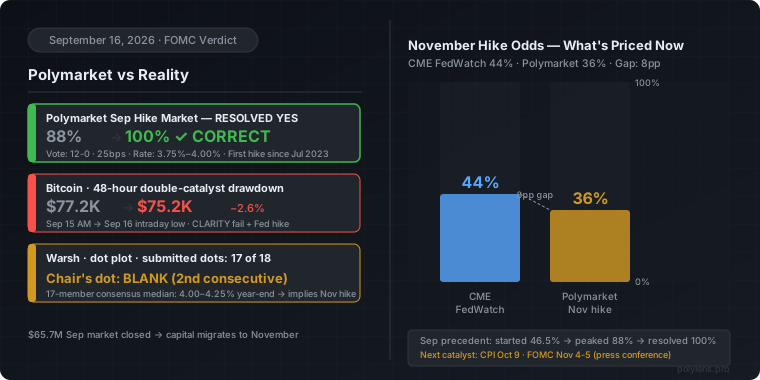
The vote came in 12-0. Twenty-five basis points. Federal funds rate at 3.75%–4.00% for the first time since 2019. Kevin Warsh, Fed Chair since February, delivered the first rate hike in three years and then walked to the podium and said something that stuck: "The plain fact is inflation is too high, and has been for too long." A unanimous vote, a hawkish chair, and a dot plot that has only one direction left to point — November.
Polymarket had this at 88% the night before. Two weeks earlier, on September 1, it was at 46.5%. The move from 46.5% to 88% in 14 days tracked the August CPI print (+0.4% monthly, the number that broke the market's ambiguity), and the crowd got there fast — faster, and ultimately more accurately, than a lot of analyst commentary that spent the week hedging between "hold" and "hike." The market resolved at 100%. The crowd was right.
What happened after the announcement is more complicated than the binary outcome. Bitcoin, which had already been under pressure from the CLARITY Act failure two days earlier, slipped below $76,000 — and briefly touched $75,200 before recovering into the evening. That's a $2,000 round-trip from the $77,200 level of September 15 morning, compressed into 48 hours of consecutive adverse catalysts. The combined impact of a major crypto regulatory failure and a hawkish Fed delivering its first hike in years produced exactly the kind of correlated sell-off that the scenario matrix in this space had outlined as worst-case.
The 12-0 Vote Nobody Was Fully Prepared For Politically
Unanimous Fed votes are not uncommon — they signal institutional consensus and deliberate communication that dissent was managed before the meeting, not during it. But this one carried a specific political weight. For months, public commentary from Trump administration officials had pushed back against rate hikes as damaging to growth. Warsh, a Hoover Institution economist with a reputation for independence, had been telegraphing hawkishness through the Jackson Hole speech on August 28 — the event that sent Polymarket's FOMC market from 46.5% to roughly 60% overnight.
The unanimous vote means either every member of the committee independently concluded inflation justified immediate action, or the pre-meeting consensus-building was unusually effective. Warsh's statement — "financial conditions are not particularly tight" — was the key phrase for market participants. It means the Fed does not see the current rate environment as restrictive. That matters for November.
Warsh Skipped His Dot for the Second Consecutive Meeting
This is the stranger story, and it may matter more for the November market than the hike itself. The dot plot — formally the Summary of Economic Projections — is the quarterly chart where each FOMC member submits an anonymous projection for the federal funds rate at year-end and further out. It has been a cornerstone of Fed communication since 2012. Kevin Warsh did not submit a projection in June. He did not submit a projection in September. Two consecutive blank dots.
The official framing is that Warsh is skeptical of forward guidance as a policy tool — he has said as much publicly, and a Fed communications review panel is reportedly weighing whether the dot plot should continue in its current form. The practical effect is that the 17 remaining dots, plotted without the chair's input, show a median year-end target of 4.00%–4.25%. That implies one more 25bp hike before December 31. The next meeting after September is November 4-5.
The political reading is different. By not submitting a dot, Warsh creates ambiguity about his own rate path while allowing the committee majority to signal hawkishness. If the dots pointed to a hold and Warsh was actually more hawkish, he'd be shown up. By abstaining, he preserves flexibility — and sends a signal to the market that his own path may be more aggressive than the 17-dot consensus suggests. For prediction market traders, a chair who won't show his cards is harder to price than one who does.
| Date | Event | Polymarket Hike Odds | BTC Price |
|---|---|---|---|
| Sep 1, 2026 | CLARITY Act at 13%, Jackson Hole aftermath | 46.5% | ~$77,400 |
| Sep 11, 2026 | Aug CPI +0.4% monthly published | 70% | ~$77,100 |
| Sep 15, 2026 | CLARITY fails 49-50, eve of FOMC | 88% | $75,600 |
| Sep 16 AM | Pre-decision, markets flat | 92% | $75,800 |
| Sep 16 2:00 PM | Fed announces 25bp hike 12-0 | 100% (resolved) | $75,200 (intraday low) |
| Sep 16 EOD | Warsh press conference hawkish | — | $75,900 |
Bitcoin's $2,000 Round-Trip and What the "Sell the News" Pattern Actually Looked Like
From the September 15 morning high of $77,200 to the September 16 intraday low of approximately $75,200, Bitcoin shed $2,000 in 30 hours across two catalysts. The CLARITY Act failure on the 15th produced the initial $1,600 drop. The Fed hike on the 16th added another $400–600 and briefly broke the $75,500 support level that had held since August.
The recovery into the evening — back to roughly $75,900 — fits the sell-the-news pattern precisely: the market had already priced in both events at very high probabilities (CLARITY at 87% failure implied, Fed at 88–92%), so the actual announcements were less shocking than the repricing that preceded them. The traders who were short into the CLARITY vote on September 15 took profit. Some of that liquidity flowed back into BTC after the Fed press conference, when Warsh's hawkishness was already reflected in price.
Coinbase closed September 16 down another 3% on top of the 8% from the 15th. Strategy (formerly MicroStrategy) added 2% to its September loss. The combined 48-hour drawdown in crypto-adjacent equities was significant enough that it showed up in broader market commentary — but notably, the equity reaction on September 16 itself was more muted than the crypto reaction. S&P 500 fell 0.6% on the day; the hike was priced in for stocks too.
The September Market Closed at 100%: Where $65M Moves Next
The Polymarket "Fed Decision in September?" market, which had accumulated $65.7M in volume since its creation, resolved YES at 100% on September 16. That's capital that needs to find a new home. The natural migration is into the November FOMC market — and that's where the interesting asymmetry now lives.
The dot plot from 17 participants (excluding Warsh) points to 4.00%–4.25% by year-end, which requires one more 25bp hike. The October meeting (October 28-29) is a one-day meeting — non-press-conference format, historically lower probability for moves. The November meeting (November 4-5) has a press conference. That structure, combined with the dot plot signal, concentrates November as the vehicle for the next hike.
Polymarket currently prices a 36% probability that the Fed will deliver two total hikes in 2026. Given that one hike has already occurred, this is effectively a 36% probability for a November hike. CME FedWatch, which had been running significantly higher than Polymarket throughout the September cycle (their divergence peaked at 13.9pp on September 1), is now at approximately 44% for November. The gap has compressed post-decision, but it hasn't closed. The same structural question that made the September market interesting — does Polymarket lag CME or lead it? — is open again for November.
The Calibration Record After Three Data Points
We now have three FOMC meetings in 2026 where Polymarket and CME FedWatch can be compared for calibration. January: both priced a hold, hold delivered. June: both priced a hold, hold delivered. September: CME at 60.4% (September 1 morning), Polymarket at 46.5% — hike delivered. CME was directionally right and numerically closer to the eventual certainty. Polymarket got there too, but later — its September 15 level of 88% vs CME's near-100% in the final hours suggests Polymarket retains a discount to CME that closes as certainty increases.
That pattern matters for November. If CME starts pricing November at 44% and Polymarket is at 36%, history suggests Polymarket will follow CME higher if inflation data continues hot. The next CPI release (October 9) and PCE data (October 31) are the two catalyst windows before the November decision. A second consecutive +0.4% monthly CPI print would almost certainly push Polymarket's November market above 60% and CME above 70%. A cooler print — say +0.2% — could collapse November odds back to 15–20%.
Warsh's Missing Dot Is a Market Signal in Itself
There's a specific implication for Polymarket traders in Warsh's dot abstention that hasn't been widely discussed: if the chair eventually submits a dot — if the communications review concludes the dot plot should continue, or if Warsh changes his approach for December — and that dot is above the 4.00%–4.25% consensus of the other 17 members, the market will have to reprice. A chair's dot that shows 4.25%–4.50% implies two more hikes rather than one. That's a low-probability but high-impact scenario for the November and December markets simultaneously.
The Bloomberg piece on Warsh's absence notes that the Fed communications panel is actively debating the future of the dot plot. If it's discontinued, forward guidance becomes harder to model — and prediction markets like Polymarket become relatively more valuable as price discovery mechanisms, because the central bank itself has reduced its signaling. If anything, the chair's hostility toward the dot plot is a reason the Polymarket Fed markets should see increasing volume over the next two meetings, not decreasing.
What the Trade Actually Looked Like Before and After
For anyone who was tracking the September market through PolyLens signals: the actionable window was August 28 to September 11. Polymarket moved from roughly 35% (mid-August, before Jackson Hole) to 88% in three weeks. The August CPI print on September 11 was the largest single-day move — approximately 20pp in 24 hours, from ~50% to ~70%. Entering at 50% with reasonable size on September 11 and exiting at 85–88% on September 14-15 was a 35-38pp move on a binary that ultimately resolved at 100%.
The exit timing was the interesting decision. At 88%, the remaining edge was 12pp — you were buying $1.00 for $0.88. That's still positive expected value if you believed the signal, but the liquidity to exit at 88% was better than the liquidity to exit at 95% in the final hours. The orderbook compressed significantly on September 15 as the market approached certainty; the spread widened to reflect thin asks above 90%. Traders who held to resolution got the full 12pp but sacrificed liquidity and timing optionality.
One Precedent Worth Holding
The 2022-2023 Fed hiking cycle — the last time the FOMC delivered consecutive hikes — saw prediction markets consistently underprice additional moves after the first one. The pattern in that cycle: each hike raised the probability of the next one by roughly 15pp above baseline, until the terminal rate came into view and the market started pricing cuts. We are, by all accounts, one hike into what could be a two-hike cycle. The September hike was not a one-off. Warsh said the economy is not in tight financial conditions. The dot plot from his colleagues signals 4.00–4.25%. The most relevant 2022 data point: after the first hike in March 2022, prediction markets gave a 40% chance to a second hike at the May meeting. The May hike came. Then June. Then July. Then September. Then November. The terminal rate was not where anyone thought it was in March 2022, and Polymarket's probabilities lagged the realized path at every step until the Fed explicitly signaled a pause.
Whether 2026 is another protracted cycle or a two-and-done sequence depends on data the market doesn't have yet. But the structural setup — CLARITY failed, crypto regulation is uncertain, inflation is above 3% across multiple categories, the chair is hawkish and abstains from the dot plot — points to more uncertainty, not less. The September market was one of the most profitable Polymarket windows of the year. The November setup is different: lower starting probability, less data certainty, earlier in the cycle. But the information edge for traders who track CME divergence, CPI surprises, and Polymarket orderbook compression is exactly the same kind of edge that paid well in September.