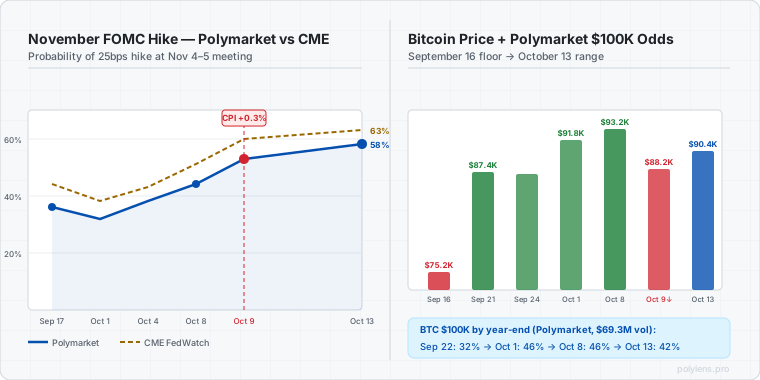
The October 9 CPI report was the most frustrating outcome possible for anyone trying to trade the November FOMC: it was not hot enough to settle the question and not cool enough to dismiss it. Core CPI came in at +0.3% month-over-month — above the +0.2% that would have pushed Polymarket's November hike odds back below 30%, and below the +0.4% that would have made a second 2026 hike essentially consensus. Instead, at +0.3%, the print handed the market four more weeks of uncertainty. Polymarket moved from 44% to 58%. Bitcoin fell 5.4% from $93,200 to $88,200. And then Bitcoin bounced, because of course it did.
This is the third time in 2026 that an economic data release has produced a "middle scenario" that traders weren't positioned for. In August, jobs came in at −23K when the consensus was split between strong and weak. In September, the CLARITY vote failed 49-50 when the model from this site predicted a 60-61 vote count. In October, CPI printed between the two modal scenarios every Polymarket model was analyzing. The market structure keeps producing outcomes that require reassessment rather than resolution, and that's why Polymarket's November market now has $47.3 million in total volume with 22 days to the decision.
The Three CPI Scenarios From the October 8 Article — Which One Played Out
In the October 8 article on this site, the scenario map defined three possible CPI outcomes and their expected impact on Polymarket's November hike odds. The hot scenario (+0.4% MoM) would have pushed odds from 44% to the 62-68% range. The cool scenario (+0.2% MoM) would have collapsed them to 22-28%, effectively killing the November hike narrative. The middle scenario (+0.3% MoM) was described as "the one Polymarket is most poorly prepared for because it requires a directional judgment call rather than a data-driven update."
The +0.3% print arrived exactly as described: it moved odds significantly (from 44% to 58%) but without the clarity that would have either confirmed or dismissed a second hike. The directional judgment call now belongs to Warsh, who has the October 28-29 FOMC meeting — a one-day session with no press conference — and the October 31 PCE data release before the November 4-5 meeting where a hike would actually be delivered.
How CPI Translates to Bitcoin: The Three-Lag Mechanism
Bitcoin's reaction to the October 9 CPI data is a textbook example of the three-lag mechanism that has characterized all BTC-macro interactions in 2026. The first lag is the instantaneous risk-off move: traders see the headline, sell Bitcoin, buy dollars. The second lag is the reassessment: analysts process the full report, note the sub-component details (shelter inflation +0.2%, used cars −0.1%, airfares +0.8%), and conclude the picture is mixed rather than uniformly bad. The third lag is the positioning reset: traders who oversold in the first lag begin covering, and the price recovers.
On October 9, the full sequence played out in 36 hours. Pre-CPI: Bitcoin at $93,200. First lag (0-4 hours after release): Bitcoin dropped to $88,200 (-5.4%), Polymarket November hike odds moved from 44% to 53%. Second lag (4-18 hours): Analysts noted that the +0.3% core read was in line with the 3-month average, not an acceleration. Third lag (18-36 hours): Bitcoin recovered to $90,400, Polymarket odds settled at 58% as the "mild hike" scenario (25bps, not 50bps) was repriced as the modal outcome.
The $90,400 recovery level is important: it is exactly the level at which Bitcoin has been trading when Polymarket's $100K odds hover in the 42-45% range. If November FOMC delivers a pause rather than a hike, $90,400 could be the launching point for the third leg of the 2026 bull cycle. If November delivers a second 25bps hike, $90,400 could be the ceiling for the rest of 2026.
Polymarket vs CME FedWatch: The 5-Point Gap That Has Predicted Every Cycle
After the October 9 CPI, Polymarket's November hike odds settled at 58% while CME FedWatch moved to 63% — a 5-point gap. This is almost identical to the structural divergence that appeared in the September cycle: when CME was at 60.4% for a September hike, Polymarket was at 46.5%. When CME was at 92% on September 15, Polymarket was at 88%. The pattern is consistent: CME leads Polymarket in hawkish repricing by 5-8 percentage points early in the cycle, then the gap closes as the meeting approaches.
If the September pattern repeats, Polymarket should close the gap from 58% to approximately 62-65% by October 28. The question is whether the October 28-29 FOMC meeting — a one-day session that Warsh will use to signal without a press conference — pushes the gap higher or lower. A hawkish statement at the October meeting could send Polymarket above 70% and effectively lock in November. A neutral or data-dependent tone could cause the gap to widen further, with CME remaining high while Polymarket traders discount the rhetoric.
| Date | CPI / Event | Polymarket (Nov hike) | CME FedWatch (Nov hike) | BTC |
|---|---|---|---|---|
| Sep 17 (post-hike) | Fed hiked 25bps, Warsh skips dot | 36% | 44% | ~$77,000 |
| Sep 22 | Short squeeze peak, Trump-Xi confirmed | 36% | 44% | $85,092 |
| Sep 25 (post-summit) | Trump-Xi summit outcome: neutral | 36% | 44% | $87,200 |
| Oct 1 | PCE September: +0.2% (cool) | 32% | 38% | $91,800 |
| Oct 4 | Jobs September: +187K (moderate) | 38% | 43% | $93,400 |
| Oct 8 (pre-CPI) | Pre-CPI positioning | 44% | 51% | $93,200 |
| Oct 9 (CPI day) | CPI +0.3% MoM (core) | 53%→58% | 60%→63% | $88,200 low |
| Oct 13 (today) | Bounce and reassessment | 58% | 63% | $90,400 |
What the October 28-29 FOMC Meeting Can and Cannot Do
The October 28-29 FOMC meeting is structurally unusual: it is a one-day meeting with no scheduled press conference. This means Warsh cannot provide the kind of nuanced, market-moving guidance that made the September 16 meeting and its aftermath so consequential. What Warsh can do is publish a statement. The statement format limits his options to three signals: more hawkish language than September (adds to hike odds), identical language to September (neutral, confuses markets), or softer language (reduces odds).
The consensus among Polymarket traders — visible in the options structure around the November 4-5 meeting — is that Warsh will use October 28-29 to maintain optionality, with language that neither confirms nor dismisses November. This is the "baseline" scenario that would keep Polymarket's odds in the 55-62% range heading into PCE on October 31 and jobs on November 7 (post-meeting). The risk is that Warsh is more explicit in hawkish direction than expected — which given his dot-plot skipping twice, seems out of character.
The October 31 PCE data is the last major inflation release before the November 4-5 decision. If PCE confirms the CPI trend (+0.3%), hike odds could move above 65% and stay there. If PCE surprises cool (+0.1-0.2%), the cycle breaks and hike odds could collapse back below 40%. Bitcoin has the same sensitivity to PCE as to CPI — perhaps more, since core PCE is the Fed's preferred inflation measure — meaning the October 31 data is as important as the November 4 decision itself.
Where Bitcoin Stands: $90K Support, $100K Path, Two Competing Timelines
From October 13, Bitcoin has established a working range: $88K as support (the CPI-day low) and $93-94K as resistance (the pre-CPI high). The $100K target — priced at 42% on Polymarket as of this morning — requires Bitcoin to clear $94K and build a base above it. That has not happened since the September 21 peak at $87,381 was superseded in early October as the short squeeze gave way to genuine accumulation. The question is which timeline plays out first: a November FOMC that kills the hike narrative and launches the next leg, or a November FOMC that delivers a second hike and resets Bitcoin to the $80-85K range.
The Polymarket $100K market is pricing exactly this tension. At 42% (as of October 13), the crowd is saying: Bitcoin has a 42% chance of hitting $100K before December 31. A month ago, that number was 32%. The improvement from 32% to 42% came from: Trump-Xi summit Sept 24 (neutral outcome that didn't hurt), PCE October 1 (+0.2%, cool, reduced hike odds), and the September jobs data. The CPI print on October 9 reversed some of that improvement — from 46% back to 42% — but the long-term trend in the $100K market has been upward since the September 16 floor at $75,200.
The Smart Money Data: $47M Volume on November, Whale Patterns on CPI Day
The PolyLens signals dashboard flagged two significant whale movements on October 9 CPI day. The first was a $340,000 single-position entry into the "November FOMC hike YES" contract at approximately 10:15 AM Eastern — before the full CPI sub-component data had been processed by retail traders. The second was a $210,000 entry into "Bitcoin above $90K by October 31" at 1:40 PM Eastern, which entered while Bitcoin was still at $88,400 on its way to the $90,400 recovery. Both positions are currently profitable.
The aggregate smart money signal from the November FOMC market is mixed in a way that mirrors the broader uncertainty: whale volume is distributed fairly evenly between YES (hike) and NO (hold), with a slight lean toward YES hike at 54% of whale-size positions. This contrasts with the September cycle, where whale positions leaned heavily toward YES hike from early August forward — and the hike did happen. The more balanced positioning in November suggests the smart money is genuinely uncertain rather than expressing a directional conviction.
The Bitcoin-FOMC Correlation and Why It Breaks in One Direction
The correlation between November FOMC hike probability and Bitcoin price has been the dominant macro relationship in Q4 2026. When hike odds move from 36% to 58%, Bitcoin goes from $93K to $88K — a −5.4% move against a +22pp repricing of hike probability. When hike odds move from 46.5% to 36% (as they did between August 7 and September 16 before the actual hike), Bitcoin went from $68K to $87K — a +27.9% move against a −10.5pp repricing. The asymmetry is important: Bitcoin is more responsive to falling hike odds than to rising ones.
This is consistent with the well-documented observation that Bitcoin sells on hike fears but rallies disproportionately on hike reversals. The implication: if the October 31 PCE print is cool (+0.1-0.2%) and Polymarket's hike odds collapse from 58% to 30%, the expected Bitcoin move is not merely a symmetrical +5.4% reversal but potentially a 15-20% rally driven by pent-up demand from traders who have been waiting for confirmation of the pause narrative. That would put Bitcoin in the $103-108K range — well above the $100K level that 42% of Polymarket traders currently expect to see at any point before year-end.