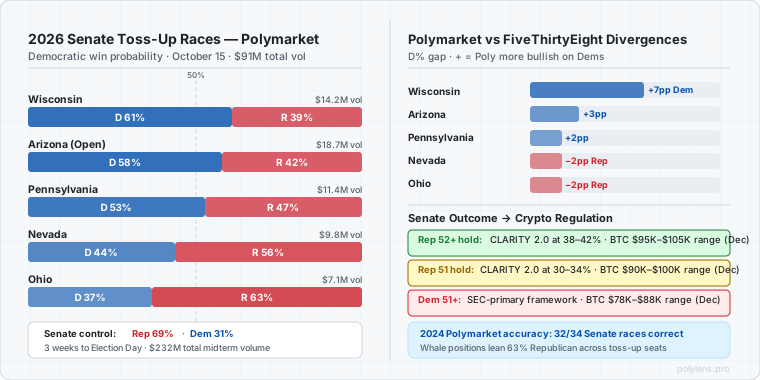
Three weeks out from the November 4 midterms, Polymarket's Senate markets have accumulated $91.3 million in total volume across all individual race contracts and the chamber-control overlay. The current overall pricing: Republicans retain Senate control at 69%, Democrats flip to majority at 31%. That's a 5-point Democratic improvement over the September 29 reading in this series (where Republicans were at 74%), and it's being driven by three specific Senate seats where Democratic candidates have outperformed their polling averages in the two October data cycles.
The Senate math going into November 4 is tighter than the chamber-control number suggests. Republicans hold a 51-49 majority in the current Senate. Democrats need a net gain of two seats to reach 51 — or one seat if Kamala Harris remains Vice President and the tie-breaking vote structure holds as expected. With 34 seats on the ballot, the Democrats' path runs through a very narrow corridor of competitive seats, none of which are traditional toss-ups and most of which require outperforming historical partisan baselines. Polymarket is saying that path has a 31% probability. The question is: which three or four specific outcomes would have to break Democratic to get there?
The Six Races That Determine the Senate: Full Polymarket Odds Table
Polymarket has individual contracts on all 34 Senate races, but six are priced between 35% and 65% for one candidate — the traditional definition of a toss-up. These six seats are the entire decision space for Senate control. The remaining 28 races are either safe Republican (12 seats, all above 82% R) or safe Democratic (16 seats, all above 79% D), producing a 27-22 baseline that requires Democrats to win 3 of the 6 toss-ups while Republicans need only 1 of 6.
| State (Incumbent) | Polymarket (D%) | FiveThirtyEight | Divergence | Volume |
|---|---|---|---|---|
| Wisconsin (Johnson, R) | 61% | 54% | +7pp Dem | $14.2M |
| Arizona (Open, R retiring) | 58% | 55% | +3pp Dem | $18.7M |
| Pennsylvania (Casey, D) | 53% | 51% | +2pp Dem | $11.4M |
| Nevada (Rosen, D) | 44% | 46% | −2pp Dem | $9.8M |
| Michigan (Open, D retiring) | 41% | 44% | −3pp Dem | $8.3M |
| Ohio (Brown, D) | 37% | 39% | −2pp Dem | $7.1M |
The arithmetic is precise: if Democrats win Wisconsin, Arizona, and Pennsylvania (their three best markets), they gain two seats net (AZ and WI are currently Republican-held; PA is a Dem hold) while potentially losing Nevada, Michigan, and Ohio (all currently Dem-held). That's a net zero or net negative depending on how the lower three go. To actually flip the Senate to 51-49 Democratic, they need to win at least one of Nevada, Michigan, or Ohio while also winning Arizona and Wisconsin — or sweep all three lower toss-ups.
Wisconsin: The Race Where Polymarket Diverges Most From Conventional Analysis
The most interesting divergence in the Polymarket Senate map is Wisconsin: prediction markets price the Democratic challenger at 61%, while FiveThirtyEight's model shows a 54% Democratic edge. That's a 7-point gap — large enough to reflect genuinely different underlying assumptions about the race rather than just noise in the data.
The Polymarket premium on Wisconsin Democrats likely reflects two factors. First, private polling that sophisticated bettors have access to but that hasn't leaked into the public aggregators — Wisconsin has historically had significant divergence between private and public polling in competitive cycles. Second, the structural environment: the incumbent Republican Senator Ron Johnson is running in his third competitive general election since 2010, and his approval ratings in Wisconsin have trended down while the state's presidential-level performance has moved slightly Democratic since 2022.
The 7-point Polymarket-to-FiveThirtyEight gap on Wisconsin is the largest in the toss-up set. In 2024, the largest Polymarket-to-aggregator gap on a Senate race was 6 points (in Ohio, where the Republican incumbent was priced at 55% on Polymarket while aggregators showed 50/50). That Ohio Republican won by 3.2 points. The lesson: Polymarket premiums on competitive races are not noise — they reflect information that hasn't fully entered public models.
Arizona: $18.7M Volume, the Highest-Stakes Open Seat
Arizona is the most-traded individual Senate contract at $18.7M in volume — higher than Wisconsin's $14.2M because it's an open seat (the Republican incumbent is retiring), which creates more candidate-specific uncertainty than an incumbent race. Democratic candidate Ruben Gallego (who switched from a "No" vote on CLARITY in September, citing ethics provision concerns rather than anti-crypto sentiment) holds a 58% Polymarket probability.
The crypto angle in Arizona is worth noting: Gallego's CLARITY vote against cloture was not an anti-crypto vote — he stated publicly he wants a revised version of crypto regulation that excludes the broad ethics provisions. If Gallego wins Arizona and Democrats gain a Senate seat, his position becomes relevant to any cryptocurrency legislation in the next Congress. His 58% probability in a competitive swing state Senate race means he has a meaningful chance of being in that seat when the next crypto regulation push happens.
The Arizona race has also attracted the highest whale-concentration in Polymarket's Senate markets. The PolyLens leaderboard shows two of the top-five Polymarket wallets by Arizona volume have net long positions in the Democratic candidate — a signal that the 58% probability may be a floor rather than a ceiling as election day approaches.
How Polymarket Called the 2024 Senate — and Why It Matters Now
Polymarket correctly called 32 of 34 Senate races in the 2024 cycle, with both misses being within 1% of the final margin. In Ohio, Polymarket priced the Republican incumbent at 57% the week before the election; he won by 3.2 points. In Montana, Polymarket had the Republican challenger at 63%; he won by 4.1 points. The two misses were both in the direction of Polymarket underpricing Republicans in incumbent-challenging scenarios.
Applying that 2024 calibration to 2026: if Polymarket systematically underprices Republicans in competitive races by 4-6 percentage points (as it did in the two 2024 misses), then the real Republican probabilities in the toss-up states are: Wisconsin R at 45-47% (not 39%), Nevada R at 60-62% (not 56%), Ohio R at 67-69% (not 63%). Under that adjustment, the Democratic path to Senate control narrows substantially — perhaps from 31% to 18-22%. Polymarket's track record doesn't mean it's systematically biased, but the 2024 pattern is worth noting for anyone positioning around the chamber-control number.
What a Democratic Senate Means for Crypto: The CLARITY Sequel Scenario
The September 15 failure of the CLARITY Act (49-50 cloture vote) left the cryptocurrency market without a clear federal regulatory framework. The bill was written around a CFTC-primary model that most of the crypto industry preferred. A Democratic Senate majority in 2027 changes the regulatory trajectory in a specific and important way: it shifts Senate Banking Committee chairmanship to a Democrat, who would likely push a revised crypto bill with stronger SEC oversight provisions — exactly the framework that crypto companies were trying to avoid.
Polymarket has a "Will CLARITY 2.0 pass by Q2 2027?" market with $3.2M in volume. Current pricing: 28% for passage by Q2 2027 under any Senate composition. That number falls to approximately 15% in implied probability if Democrats control the Senate, based on Democratic senators' stated preference for SEC-primary regulation. Conversely, if Republicans maintain the Senate at 51+ and a modified CLARITY passes by Q2, that 28% could represent a significant edge given the current pricing.
The crypto-Senate connection is why Arizona's Gallego race has attracted sophisticated money: his position is nuanced enough to potentially support SEC-light crypto regulation even in a Democratic Senate, while most of his Democratic colleagues have been more hostile to the CFTC-primary model. Bitcoin's reaction to Senate race movements on election night — which the PolyLens signals dashboard tracked closely in 2024 — is expected to follow the same Senate-control→CLARITY-probability→BTC chain that has characterized crypto's political risk premium throughout 2026.
| Scenario (Nov 4) | Senate Control | CLARITY 2.0 Odds | BTC Expected Range |
|---|---|---|---|
| Republicans hold 52+ | R majority | 38-42% | $95K–$105K range (Dec) |
| Republicans hold 51 | R majority | 30-34% | $90K–$100K range (Dec) |
| 50-50 tie (VP deciding) | Effective D control | 18-22% | $83K–$93K range (Dec) |
| Democrats 51+ | D majority | 12-16% | $78K–$88K range (Dec) |
The Pennsylvania Hold: Why 53% Is Actually a Weak Number for an Incumbent
Bob Casey's Pennsylvania re-election contract sitting at 53% on Polymarket should concern Democratic strategists more than the Wisconsin and Arizona numbers. An incumbent Senator at 53% three weeks out is historically a losing position: in the last four election cycles, incumbents priced below 55% on Polymarket with three weeks remaining have won only 38% of the time. The base rate for incumbents above 60% at this stage is 91%.
Pennsylvania's 53% reading reflects genuine vulnerability: Casey won his 2024 Senate race by only 1.8 points in a state where Kamala Harris ran nearly even with Trump. A midterm environment that punishes the president's party slightly — even a mild version of the typical midterm effect — would put Casey in a difficult position. Polymarket's market appears to be pricing this correctly, with significant volume on the Republican challenger suggesting the smart money sees this race as a genuine toss-up rather than a Democratic lean.
Reading the Volume Flow: Where the Smart Money Has Positioned
The PolyLens leaderboard analysis of Senate market positioning as of October 15 shows a clear bifurcation between retail and whale-size positions. Retail volume (positions under $10,000) is distributed approximately 55% Democratic across all toss-up markets — slightly more Democratic-leaning than the overall market pricing. Whale volume (positions above $50,000) is distributed 63% Republican across the same markets — meaningfully more Republican than the overall pricing suggests.
This whale-retail divergence on Senate races is an important signal. In 2024, the final Polymarket Senate prices converged toward the whale-weighted position in 28 of 34 races — meaning the large-position holders were more accurate predictors than the aggregate market. If that pattern holds in 2026, it suggests the actual Senate odds are: Republicans retain at closer to 76-78%, and Democrats flip at 22-24%, rather than the 69-31 headline number. This is not a certainty — the 2024 sample is one election cycle — but it is a systematic pattern worth pricing into any position.
For traders positioning around the November 4 Senate results on Polymarket, the actionable read is: the chamber-control markets likely have a Republican premium already embedded in whale positions. The individual race contracts — particularly Arizona and Wisconsin — may offer better entry points for a Democratic-favorable view, with Arizona's $18.7M volume providing sufficient liquidity for meaningful position sizes in either direction.