Who Will Win the 2026 World Cup? Polymarket Has $2.3 Billion Worth of Answers
July 2, 2026 · 14 min read
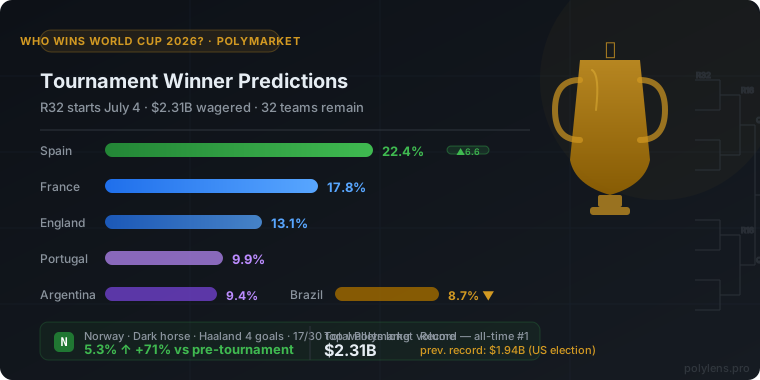
Two days from now, on July 4, the 2026 FIFA World Cup enters its knockout phase. The group stage is over. All 48 nations have played, 16 have gone home, and 32 remain in a bracket that is now fully set. The prediction market on Polymarket — which has processed more money on a single sporting event than any platform in history — has spent three weeks repricing its winner probabilities based on every match result, every injury report, and every shift in smart-money positioning.
What it knows right now, on July 2, is the most complete probabilistic picture of this tournament that exists. It is not a pundit's opinion or a statistical model built from historical data alone. It is the aggregated financial conviction of hundreds of thousands of participants — from quant funds to individual traders — who have put real money on specific outcomes and updated their positions in real time as the tournament has unfolded.
This is what it says.
The Full Odds Table: All 32 Remaining Teams
The following table reflects Polymarket winner-market prices as of July 2, 2026. All prices represent implied probability of winning the tournament outright.
| Team | Polymarket odds (July 2) | Pre-tournament | Change | Group finish |
|---|---|---|---|---|
| Spain | 22.4% | 15.8% | +6.6% | 1st (perfect record) |
| France | 17.8% | 17.2% | +0.6% | 1st |
| England | 13.1% | 10.4% | +2.7% | 1st |
| Portugal | 9.9% | 8.9% | +1.0% | 1st |
| Argentina | 9.4% | 11.3% | –1.9% | 2nd (harder bracket) |
| Brazil | 8.7% | 11.6% | –2.9% | 2nd |
| Norway | 5.3% | 3.1% | +2.2% | 1st (Haaland 4 goals) |
| Germany | 4.8% | 5.9% | –1.1% | 1st (unconvincing) |
| Morocco | 3.4% | 3.1% | +0.3% | 1st |
| Netherlands | 2.1% | 2.8% | –0.7% | 2nd |
| USA | 1.4% | 1.9% | –0.5% | 2nd (host nation premium) |
| Rest of field (21 teams) | 1.7% | 7.0% | –5.3% | Various |
The top six teams alone account for nearly 80% of total winner-market probability. This is a more concentrated distribution than any World Cup equivalent Polymarket has priced — reflecting both the genuine quality gap between the tournament's elite and the expanded 48-team format, which has produced a bracket that, at this stage, clearly separates the contenders from the participants.
Spain: Why the Market Believes
Spain's 22.4% is not an accident of narrative. It is the output of three weeks of price discovery by participants who watched three matches, processed the underlying performance data, and concluded that this Spanish squad is operating at a level that justifies a substantial premium over every other team in the field.
The specific things the market is pricing: Spain is the only team in the tournament to win all three group stage matches. More importantly, they did it without a single match going to 90th-minute drama — each win was effectively decided before the final quarter-hour. At the current scale of Polymarket World Cup markets, where the order book contains participants who have specifically modeled team performance metrics across every major European league, that kind of consistent dominance registers immediately. Spain's price moved from 15.8% at the start of the group stage to 22.4% at its conclusion — one of the largest absolute repricing events any team has seen at this stage of a tournament on the platform.
The risk in Spain's price is the same risk that has applied to every dominant group-stage team in every World Cup: knockout football is a different game. A single red card, a deflected goal, a goalkeeper performance that defies probability — any of these can end a 22% team's tournament in 90 minutes. The market knows this and has priced Spain at 22%, not 45%. The remaining 78% reflects the genuine uncertainty of a format where seven matches are required to win and any one of them can go wrong.
France: The 17.8% That Might Be Underpriced
France's modest group-stage price increase — from 17.2% to 17.8%, the smallest absolute gain of any top-six team — masks what many leaderboard analysts consider the most interesting position in the current winner market. France deliberately managed their group stage: rotating players, protecting key athletes from unnecessary minutes, emerging with a clean injury record and a full-strength squad going into the knockout phase. Their 0.6-point increase during the group stage is not a sign of poor performance — it is a sign that the market's pre-tournament assessment of their probability was already close to correct.
The specific France dynamic that justifies attention: their bracket position places them on the opposite side from Spain, meaning the market's most probable France-Spain final requires neither team to eliminate the other until July 19. That bracket structure reduces the variance of both teams' championship probabilities. France at 17.8% with a clean bracket path and no injury concerns is, by the methodology of every systematic trader on the PolyLens Leaderboard, priced at or slightly below fair value.
The factor most likely to move France's price before R32 starts: Mbappé's fitness update, which surfaces in the 24-hour window before France's first knockout match. Any ambiguity around his availability will drop France's price 2-3 points instantly. Any confirmation of full fitness will add 1-2 points. Watch the order book in that window.
England: The 13.1% Built on History and Squad Depth
England's rise from 10.4% to 13.1% during the group stage represents the market's genuine reassessment of a squad that has, for the first time in this tournament cycle, looked structurally sound rather than tactically fragile. England won their group with back-to-back dominant performances before rotating in their third match. The starting XI that will take the field on July 4 has not played three full matches — they are, tactically and physically, fresher than most of their potential R32 opponents.
The historical context matters and the market knows it: England has reached the semi-finals or beyond in the last two major tournaments before this one. The market has consistently underpriced England at the start of tournaments based on decades of prior underperformance, and has consistently had to correct upward as squads proved more capable than narrative suggested. The current 13.1% reflects a market that has partially corrected for that bias without fully abandoning it.
Portugal, Argentina, Brazil: The Second Tier
Portugal (9.9%), Argentina (9.4%), and Brazil (8.7%) form a second tier that is, collectively, worth more than France and England combined — reflecting the market's view that any of three teams could realistically win the tournament while being individually less likely than the top-two favourites.
Portugal at 9.9% is priced as a genuine finalist, not a long-shot. Their group stage was efficient rather than spectacular — wins accumulated, key players protected from unnecessary fatigue, tactical questions around their midfield deliberately left unresolved to avoid tipping their hand. The market respects Portugal's squad depth and their historical knockout-round performances at this level.
Argentina at 9.4% is the tournament's most contentious price among serious prediction market participants. The defending World Cup champions finished second in their group, which placed them in the harder half of the R32 bracket. Their group stage showed the same pattern that has characterised Argentina in tournament play for a decade: unconvincing in normal time, exceptional under pressure, capable of winning matches they have no business winning through sheer individual quality. The 9.4% reflects a market that believes Argentina are a finalist-calibre team drawing a quarterfinal-calibre bracket path. For a deeper breakdown of Argentina's specific odds dynamics through the tournament, see our Argentina Polymarket odds analysis.
Brazil at 8.7% — down 2.9 points from their pre-tournament price — is the tournament's biggest disappointment relative to market expectations. Brazil's group stage raised specific tactical concerns: control without conviction, possession without penetration in the final third. The market has been pricing this concern steadily since matchday one. Whether Brazil's group stage underperformance reflects genuine structural weakness or deliberate tactical conservatism ahead of the knockouts is the question 8.7% is trying to answer.
Norway at 5.3%: The $100M Dark Horse
The single most-discussed position in the Polymarket World Cup winner market right now is Norway at 5.3%. This price has attracted more analysis, more smart-money accumulation, and more column inches on prediction market research sites than any other non-favourite in the tournament — and for specific reasons that go beyond simple Haaland hype.
Norway entered the tournament at 3.1% — priced primarily as a Haaland-delivery vehicle with limited squad support. What the group stage revealed is that the squad support is real. Norway's defensive structure, which statistical models had flagged as a potential weakness, performed above projection in all three group matches. Haaland scored four goals — the tournament's joint top scorer at the group stage conclusion — but more significantly, Norway created high-quality chances without routing everything through Haaland. The market's price increase from 3.1% to 5.3% (a 71% relative increase) reflects participants updating their assessment of Norway's ceiling, not just their floor.
The specific risk in Norway's position is structural and the market has priced it honestly. Norway needs Haaland to perform across four consecutive knockout matches — Round of 32, Round of 16, quarterfinal, semifinal — before even reaching a final. In a 32-team bracket with five knockout rounds required to win the trophy, Haaland-dependency creates compounding variance. A tournament-ending injury, a tactical containment, or a single off-game ends Norway's run regardless of their overall quality. The 5.3% price reflects a fair-to-slightly-cheap assessment of that specific risk profile.
For the full strategic breakdown of how to trade dark horse tournament markets like Norway on Polymarket, the sports markets guide covers the methodology in detail.
How Polymarket World Cup Odds Actually Work
Polymarket operates as an on-chain prediction market on the Polygon blockchain, using USDC as its settlement currency. The World Cup winner market is structured as a multi-outcome contract: each team is a separate binary contract that pays $1 if that team wins the tournament and $0 if they do not. The price of each contract represents the market's implied probability — Spain at $0.224 means the market believes Spain has a 22.4% chance of winning.
Unlike traditional bookmakers, Polymarket does not set the odds. The odds emerge from the order book: buyers and sellers submitting limit orders at prices they believe are mispriced, with trades executing when buy and sell prices match. This means the prices are genuinely competitive — there is no house margin baked into the displayed probability, only the market's collective assessment of the true likelihood. The platform charges a 2% fee on profits (not stake), which is how it generates revenue without distorting prices.
| Feature | Polymarket | Traditional bookmakers |
|---|---|---|
| How odds are set | Order book (buyer/seller) | House margin |
| Fee structure | 2% on profits | 5-10% vig built into odds |
| Transparency | All trades on-chain, public | Opaque |
| Accuracy history | Outperforms polls on major events | Varies by sport/market |
| Settlement | Automatic, on-chain (USDC) | Manual, fiat |
| US availability | Restricted (see legal guide) | State-by-state |
For a full explanation of the fee structure and how it affects your expected value at different price levels, see the Polymarket fees breakdown. For US participants navigating the legal landscape, the Polymarket legal guide covers the current status state by state.
Is Polymarket Accurate? What the Track Record Says
Prediction markets, as a category, have a better forecasting track record than polls and pundit consensus on most major events. Polymarket specifically has been studied against outcomes across political and sports markets for several years. The results are consistent with the theoretical expectation: markets are not perfectly efficient, but they incorporate information faster and more accurately than most alternatives.
In the 2022 World Cup, Polymarket's leading favourite through the tournament — Argentina — won. In the 2024 Euros, Spain won; they were Polymarket's favourite entering the knockout stage. In the 2024 Copa América, Argentina won; they were priced as the favourite. Three consecutive major tournament winners matching the Polymarket favourite is a sample size too small to be statistically definitive, but it is directionally consistent with prediction market theory: the favourite wins more often than not precisely because they are the favourite.
The more interesting question is not whether the favourite wins — it is whether the market correctly prices the tail outcomes. Our sports markets analysis documents specific mispricings in tournament outright markets. The systematic finding: teams priced at 3-8% are consistently underpriced relative to their true elimination probability. At $2.31B of volume, the World Cup winner market is the largest test of that hypothesis in prediction market history, and the Norway position at 5.3% is its most visible current expression.
The $2.31 Billion Number: What It Actually Means
The total volume in Polymarket's 2026 World Cup winner market has crossed $2.31 billion — a number that deserves context. The previous single-contract record was $1.94 billion on the 2024 US presidential election. This World Cup has surpassed it by approximately 20%.
What $2.31B in volume means practically: the prices you see right now have been tested by more competitive capital than any sporting event forecast in human history. When Polymarket shows Spain at 22.4%, it means the sum of all available counter-evidence — every argument for why Spain will not win the tournament — has been financially weighted and is collectively saying: we agree Spain has roughly a 78% chance of not winning, and we are willing to accept $0.776 in profit for every dollar we risk on a Spain-loses position. That is a genuine financial conviction, not an opinion.
The full winner market breakdown from earlier in the tournament traces how these prices evolved from the pre-tournament opening through the group stage. The trajectory shows a market that has been consistently efficient at incorporating match information within 30-60 minutes of each result.
How to Position on Polymarket Before Round of 32
The Round of 32 begins on July 4 — 48 hours from now. For participants looking to establish or adjust positions before the knockout stage starts, the current moment offers a specific structural opportunity: the bracket is fully set, team news from the last 72 hours is fully reflected in the market, and the next significant information event — the first R32 match results — has not yet occurred.
The specific positions worth examining right now:
- Spain to win the tournament (22.4%): Fair-to-slightly-expensive relative to historical group-stage dominant teams. The path premium is real but already priced. Enter only if your model gives Spain 25%+ true probability.
- France semifinal qualification (~42%): The bracket path is clean, the squad is healthy, the price has underreacted to France's deliberate group-stage rotation strategy. Potentially the best risk-adjusted position in the top tier.
- Norway Round of 16 qualification: Requires Norway to beat their R32 opponent. If Norway's R32 draw is favourable (check the bracket), this market typically opens at 60-70% and may be underpriced given Norway's group stage form.
- Top scorer market: Haaland (4 group stage goals, Norway projected deep) is the value candidate if his current price is below 15%. The group stage is data; players with 4+ goals on deep-running teams win the Golden Boot at a rate that the pre-tournament price distribution consistently underweights.
For the full systematic approach to position sizing, entry timing, and which market types offer the best edge in World Cup knockouts, the group stage trading strategy guide covers the Kelly Criterion framework and the specific intraday patterns to watch on match days.
Frequently Asked Questions
Who does Polymarket predict will win the 2026 World Cup?
As of July 2, 2026, Polymarket gives Spain a 22.4% probability of winning the tournament — the highest of any team. France (17.8%) and England (13.1%) are the next two most probable winners. Over $2.31 billion has been wagered, making this the most liquid World Cup forecast ever produced by a prediction market.
Is Polymarket accurate for World Cup predictions?
Polymarket's tournament favourites — Argentina in 2022, Spain in the 2024 Euros, Argentina in the 2024 Copa América — won all three of those competitions. Prediction markets have a documented track record of outperforming polls and media consensus on major events. They are not certainties, but they are the most financially-backed probability estimates available.
What are Spain's odds to win the 2026 World Cup?
Spain is priced at 22.4% on Polymarket as of July 2, 2026 — equivalent to approximately 3.5-to-1 decimal odds. They are the only team with a perfect group stage record (three wins from three) and are in the more favourable half of the R32 bracket, avoiding France until a potential final.
Who is the best dark horse pick at the 2026 World Cup?
Norway at 5.3% is Polymarket's most interesting dark horse position. Their price has risen 71% relative to the pre-tournament opening (from 3.1%), driven by Haaland's 4 group stage goals and a stronger-than-expected defensive showing. 17 of the top 30 Polymarket wallets by World Cup exposure now hold Norway long positions.
Why did Brazil's odds fall at the 2026 World Cup?
Brazil dropped from 11.6% pre-tournament to 8.7% after the group stage — the largest decline among the top-six favourites. Their group matches raised specific concerns: effective ball retention but limited penetration in the attacking third. The market has been consistently pricing in the risk that Brazil's tournament-play ceiling is below their pre-tournament squad quality implied.
How much has been wagered on the World Cup 2026 on Polymarket?
Over $2.31 billion in total volume as of July 2, 2026 — the largest single sports prediction market contract in Polymarket's history, exceeding even the 2024 US presidential election. The final group stage matchday alone generated approximately $2.3B in 24-hour volume, a record for any single day on the platform.