Polymarket World Cup 2026: The Final Group Stage Day Is the Most Complex Trade of the Year
June 30, 2026 · 13 min read
Why Today Is Different From Every Other Day of the Tournament
For the past three weeks, the 2026 FIFA World Cup has unfolded across venues in the United States, Canada, and Mexico — the largest field in tournament history, with 48 nations competing across 12 groups. Polymarket has been the most liquid English-language prediction market for the event, with outright winner markets, group advancement markets, and individual match markets all active simultaneously.
The first wave of group conclusions — Groups A through F — produced the tournament's highest single-day volume on June 25: a record $340M in pre-match open interest and the kind of correlated price action that separated prepared traders from reactive ones. Today, the final six groups complete their third matchday, finishing the bracket and setting the full picture for the Round of 32 that begins July 4.
The final matchday of each group is structured so that both matches kick off simultaneously — FIFA's anti-collusion rule, in place since 1982. On Polymarket, this creates something that doesn't exist at any other point in the tournament: a web of correlated, live-resolving markets where a goal scored in one match instantaneously moves prices in four or five adjacent markets.
If you understand that structure, you can position ahead of it. If you don't, you are reacting to price moves that sharp traders anticipated hours or days in advance.
The Correlated Market Problem: How Final Group Day Breaks Most Traders
Consider a simplified example. Group X has two final-day matches happening simultaneously. Team A currently sits in second place and needs either a win, or for Team C (in the other match) to draw. On Polymarket, there are active markets for:
- "Will Team A advance from Group X?" — currently priced at 0.68
- "Will Team A win Group X?" — currently priced at 0.31
- "Will Team C advance from Group X?" — priced at 0.44
- "Will Team A win the 2026 World Cup?" — outright, priced at 0.07
- "Will Team A reach the quarterfinals?" — priced at 0.29
These five markets are not five independent bets. They share the same underlying probability — the outcome of Team A's group stage situation. But they are maintained by separate order books, updated by different sets of participants at different speeds. In the 20 minutes after the final group matches kick off and early results become clear, these markets will reprice — but they will reprice at different rates. The advancement market updates fastest because it is the most obvious. The outright winner market updates slowest because it requires participants to chain group qualification → knockout path → final probability, which is cognitively harder.
That lag is where the edge is. A sharp trader who knows Team A is through to the Round of 32 before the outright market fully reflects it can buy the outright at a price that no longer reflects the true state of the world. This is not inside information — it is the same public information, processed faster and in more dimensions simultaneously.
The Third-Place Wildcard: The Most Underpriced Market of the Tournament
The 2026 World Cup expanded to 48 teams with a new format: the top two finishers from each of the 12 groups advance automatically, plus the eight best third-place finishers across all groups. That means 32 teams total reach the Round of 32.
The eight best third-place teams qualification market is, by far, the most systematically mispriced market category in the entire tournament. Here is why:
Retail participants understand "win the group" and "finish second." They do not naturally reason about the tiebreaker mechanics for third-place qualification — which groups tend to produce stronger third-place finishers, how goal difference across groups compounds, which third-place team from which group historically has the hardest path forward once qualified. The result is that third-place advancement markets for teams that have legitimate qualification chances are consistently trading 15-30% below their statistically defensible probability.
Today, with the group stage concluding, the markets for these teams will be at maximum volatility. A team on 3 points that currently projects as one of the best eight third-place finishers globally may be trading at 0.40 on Polymarket — even though the correct probability, accounting for all concurrent group results, is closer to 0.62. The uncertainty is not in the outcome; it is in the market's failure to aggregate information across 12 simultaneous group conclusions.
What the Polymarket Order Books Look Like Right Now
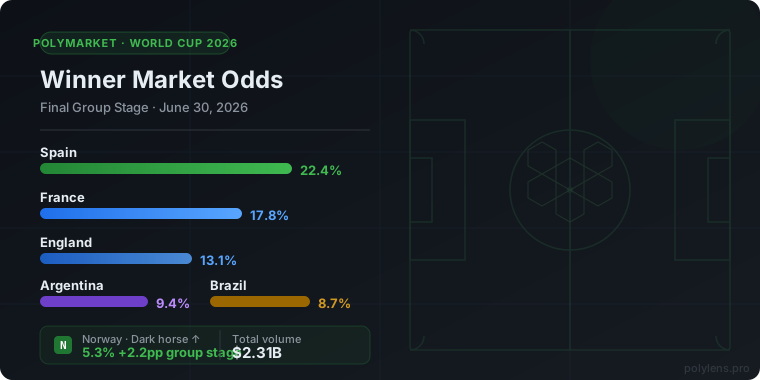
As of this morning, the outright winner market on Polymarket shows the structure you would expect at this stage: Spain leads at 22.4% after their perfect group stage, France close behind at 17.8%, England at 13.1%. The pre-tournament favorites — France, Brazil, England, Spain, Argentina — collectively absorb roughly 65% of the implied probability. Germany, Portugal, and one or two emerging dark horses split another 20%. The remaining 15% is distributed across 40+ other teams, many of them already eliminated.
What is interesting is not the top of the distribution. It is the middle tier — specifically, teams currently priced between 0.03 and 0.08 on the outright market that have just confirmed their Round of 32 place. These teams are entering the knockout phase with:
- A confirmed bracket path (their Round of 32 opponent is known or becoming known now)
- Momentum from a strong group stage finish
- Market prices that were set before their final group result and have not yet repriced
The window between a team confirming advancement and the market fully updating their outright price has historically produced some of the sharpest short-duration edges in Polymarket sports. We documented one version of this pattern in our wallet case study — a position entered at 1 cent that ballooned to six figures. The mechanism was the same: the market had not yet processed publicly available information into the correct probability.
The Bracket Effect: Why Opponent Matters More Than Seed
Most retail Polymarket traders think about World Cup qualification in terms of ranking — a higher-ranked team is more likely to advance, so they deserve a higher price. This is true but incomplete. What matters for a specific team's tournament-winning probability is not just their own quality — it is the specific path through the bracket that their group position has assigned them.
A team that finishes second in their group may face the winner of a particularly weak group in Round of 32. A team that wins their group outright may draw an opponent from a group that produced multiple high-quality teams. The bracket path for a second-place finisher can be objectively easier than the path for a first-place finisher in a different group.
| Finishing Position | Polymarket Retail Assumption | Reality |
|---|---|---|
| Group Winner | Better team, deserves higher price | May draw a stronger opponent in R32 depending on bracket |
| Group Runner-Up | Weaker team, lower price justified | May draw a weaker opponent from a different bracket slot |
| 3rd Place Qualifier | "Didn't even win their group" — priced punitively low | Bracket path sometimes the clearest road to QF of any team |
Today, as the bracket for the Round of 32 completes, this mispricing is at its maximum. Argentina's group position — they qualified second and face a harder bracket half — is a case study in this: their price dropped nearly 2 points on the bracket draw alone, before group-stage performance data was even factored in. For more on how Argentina's specific odds have evolved through the tournament, see the Argentina Polymarket odds breakdown. Teams are getting assigned to bracket slots in real time, and the market is updating outright prices based on seed position rather than the specific opponent matchup that position implies. Traders who have pre-modeled the bracket paths under different group outcome scenarios can identify which teams have been mis-slotted by the market narrative before that narrative self-corrects.
Volume Dynamics: The World Cup Is Polymarket's Biggest Sports Liquidity Event
One structural feature of the 2026 World Cup on Polymarket that distinguishes it from any other football tournament: volume. The Champions League, the Copa América, the Euros — all generate significant Polymarket activity. The World Cup, especially in its first North American edition, has generated liquidity that dwarfs all prior football markets by a factor of several times.
High volume is generally good for traders because it tightens spreads and makes larger positions possible without moving the market. But at this specific moment — final group day — it creates a paradox. Volume is highest precisely when the order books are most unstable. Prices are moving rapidly, spreads widen temporarily as market makers hedge exposure, and the apparent liquidity in the book may not survive a major result.
The flip side of today's volatility is opportunity. In the 48 hours after the group stage concludes — from tonight through July 2 — the market will be digesting a clean, fully resolved group stage picture. Advancement is confirmed for 32 teams. The bracket is set. Outright winner and round-specific markets will reprice from a position of full information. For traders who did their modeling work in advance, this is the moment to enter positions in the knockout phase markets at prices the market will soon recognize as incorrect.
Top Scorer Markets: The Overlooked Opportunity
The Golden Boot — top scorer of the 2026 World Cup — is one of the most consistently mispriced tournament markets on Polymarket. The reasons are structural and predictable.
Retail participants in top scorer markets anchor to pre-tournament favorites: the globally recognized strikers who receive the most media coverage. These players are systematically overpriced. The empirical pattern in past World Cups is clear: the tournament's top scorer is, as often as not, a player from a team that performs better than expected and therefore plays more games. A team that reaches the final plays seven matches; a team eliminated in the Round of 32 plays four. A striker on a deep-run team accumulates goal opportunities the market did not price at the start of the tournament.
By June 30, the group stage is complete and we know two things that were uncertain before the tournament started: (1) which teams have qualified for the knockout phase, and (2) which strikers have demonstrated form in the group stage. Cross-referencing these two facts against Polymarket's current top scorer prices will reveal, with high probability, at least one or two players trading at significant discount to their true probability.
Positioning for the Round of 32: The Three Markets Worth Trading Now
As the group stage concludes today, three specific market categories will produce the best risk-adjusted opportunities over the next two weeks.
1. Individual Round of 32 match markets (opening tonight and tomorrow). As brackets crystallize, match markets for the Round of 32 (beginning July 4) will open with initial prices based on pre-tournament form. In the 12-36 hours before each match, these prices will be the least informed they will ever be — set before team news, injury updates, and tactical information becomes available. The first 12 hours of an open market is often its least efficient state. Watch for group stage information that the market hasn't yet integrated into R32 match pricing.
2. Quarterfinal and Semifinal qualification markets. Once the R32 bracket is set, markets for "Will Team X reach the quarterfinals?" and "Will Team X reach the semifinals?" become tractable. A team that qualified second from a group may have a cleaner bracket path to the QF than the group winner — and the market will price them at a discount purely based on finishing position. These discounts are correctable within 48-72 hours as analysts publicly map the bracket paths. Enter before that consensus forms. The Round of 32 bracket odds breakdown has the full structural analysis of which paths benefit which teams.
3. Outright winner repricing. The biggest single opportunity of the knockout phase comes when a major early-round upset eliminates a heavily-backed favorite. The favorite's market resolves; all the capital that was in their corner needs to go somewhere. Some of it flows rationally to the next-best teams. Some of it flows emotionally to the team that just caused the upset, regardless of whether that team is a genuine deep contender. The emotional inflow to the upset winner is nearly always an overreaction. If a major upset happens in R32, the correct trade is usually: (a) the team that caused the upset is overpriced immediately after, and (b) teams that benefited from the bracket clearing are underpriced by comparison. Look at who was in the same half of the bracket as the eliminated favorite — their path just got significantly easier, and the market will be slow to reflect that.
| Market | Entry Timing | Edge Source | Risk Level |
|---|---|---|---|
| R32 match winner (specific games) | First 12h after market opens | Team news and form not yet priced | Medium |
| Quarterfinal qualification | Within 24h of bracket set | Path difficulty not reflected in seed-based pricing | Medium-Low |
| Outright winner (post-upset) | 30-90 min after major upset resolves | Emotional repricing misdirects capital | Medium-High |
| 3rd-place wildcard advancement | During final group matchday | Cross-group tiebreaker complexity | High (today only) |
| Top scorer (group stage complete) | Now — tonight | Retail anchored to pre-tournament names | Medium |
The Size Question: How Much to Bet on World Cup Markets
World Cup markets on Polymarket attract larger positions than any other football event. The combination of high public interest, long resolution timelines (matches resolve definitively), and deep liquidity relative to other sports markets makes them feel like a safer place to deploy larger capital. That feeling is partially justified — deeper books do reduce slippage risk. But it creates a second-order problem: traders who would cap a Champions League bet at $500 find themselves placing $3,000 in World Cup markets, telling themselves the liquidity justifies it.
The correct position sizing logic doesn't change because the tournament is prestigious. Use the same fractional Kelly approach you would for any market. The formula:
Where b = net odds (if you buy at 0.07, b = 13.3), p = your estimated true probability, q = 1 − p
Example: Outright at 0.07, your model says true probability is 0.13
f* = (13.3 × 0.13 − 0.87) / 13.3 = (1.73 − 0.87) / 13.3 = 6.5% of sports bankroll
Apply half-Kelly in practice: 3.25%. World Cup model uncertainty is high.
Two specific rules for World Cup sizing: First, never let your total exposure across all World Cup markets exceed 30% of your total prediction market bankroll — not because individual markets are riskier, but because they are all correlated. If France wins the tournament, every market where France was relevant resolves in one direction. Your positions are less independent than they appear. Second, reduce size by 50% on markets that are currently pricing in maximum uncertainty — specifically, any market involving group stage outcomes that haven't yet resolved today. You do not have edge in the outcome of the match itself; only in the market's failure to correctly price the implications of different outcomes in advance.
Using the Leaderboard to Find Who Got Group Stage Right
The PolyLens Leaderboard will be at its most informative over the next 24-48 hours. As group stage markets resolve across all 12 groups, the traders who correctly called group outcomes at favorable odds will show substantial P&L spikes. These are the wallets worth tracking into the knockout phase.
The reason is simple: a trader who correctly priced Group C advancement markets is demonstrating one of two things. Either they have a calibrated probability model that outperformed the market — in which case their knockout phase positions will likely also have edge. Or they got lucky — in which case their knockout phase positions will revert to average. You cannot distinguish these cases from a single tournament. But if a wallet shows consistent outperformance across multiple group markets (not just one), the probability that it is model-driven rather than luck-driven is substantially higher.
Wallets with 5+ correct group advancement calls at prices that implied the market was underweighting their probability are the most informative signals in the leaderboard right now. Check their current open positions — specifically any outright winner or round qualification markets they have entered in the last 48 hours. These are the traders who have been right about the group stage structure; their knockout phase bets are worth the most attention.
The Telegram bot sends real-time alerts when high-win-rate wallets open new positions. With the bracket crystallizing today, expect a cluster of new positions from tracked wallets in the next 12 hours as the group picture becomes clear. That timing is not coincidence — these are the traders who have been waiting for exactly this moment to enter knockout phase markets at the first available prices.
The Historical Pattern: What Happens to Polymarket Prices on Final Group Day
Looking at prior Polymarket tournament data — the 2024 Copa América, the 2024 Euros, and earlier stages of this World Cup — a consistent intraday pattern emerges on final group matchday:
- Pre-kickoff (T-2 hours): Prices are relatively stable. Retail volume is moderate. Sharp traders have already positioned. The book reflects the pre-match consensus.
- Kickoff to minute 30 (T+0 to T+30): Prices begin moving as early match developments emerge. If any result is diverging from the expected scenario, prices cascade across related markets. This is the highest-velocity period.
- Minute 30 to halftime: Some stability as early patterns are absorbed. If the first-half result is broadly consistent with expectations, prices stabilize near their new equilibrium. This is a reasonable entry window for pre-modeled positions that haven't triggered yet.
- Second half: Volatility spikes again as resolution becomes imminent. Markets begin pricing in the final state. Spreads widen as market makers reduce risk. Position entry becomes expensive.
- Post-resolution (T+1h to T+6h): The most efficient repricing of outright and round-specific markets. Rational capital flows to correctly priced positions. Emotional overreaction to upset results creates the next wave of mispricings.
What the World Cup Tells Us About Polymarket as a Market Mechanism
The 2026 World Cup is the largest stress test Polymarket sports markets have faced. The combination of volume, global interest, format complexity (12 groups, wildcard advancement, an expanded bracket), and simultaneous resolution events is unprecedented in the platform's history.
What it reveals is that Polymarket sports markets are efficient at processing simple binary outcomes quickly, but slow to aggregate multi-step conditional probabilities. A "did Team A win the match?" market resolves and reprices in minutes. A "given that Team A won and Team B drew, does that change Team C's outright winner probability?" question takes significantly longer for the market to answer correctly — because it requires participants to chain probabilities across multiple resolved and still-live events simultaneously.
That processing lag is the fundamental source of edge in World Cup markets. It does not require insider information or superhuman statistical modeling. It requires doing the conditional probability math that the market is slow to do, entering before the market catches up, and holding to resolution with correct position sizing. That is as close to repeatable, structural edge as prediction market trading offers.
The tournament continues through July 19. The group stage ends today. The most complex single day of Polymarket football trading of the year is happening right now — and the most interesting bracket positions will be clear by tonight. For methodology on how we track and analyze these market patterns over time, see our broader sports markets guide.