Starship Flight 13 Has Aborted Twice. SPCX Stock Is Down 45% From Its Peak. Here's What Polymarket's $665K Market Is Pricing for What Comes Next.
July 23, 2026 · 16 min read
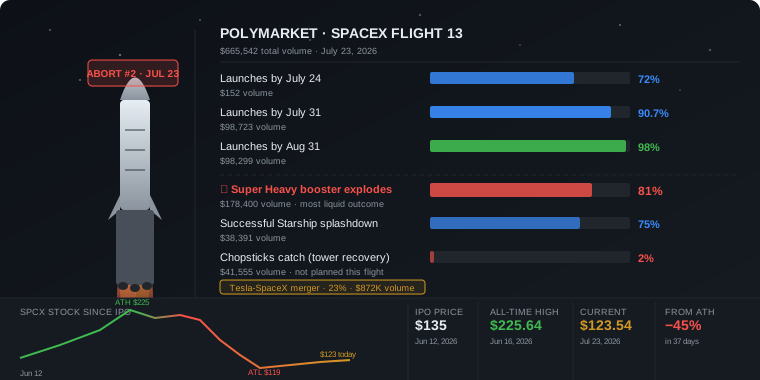
SpaceX's IPO was supposed to be a moment of arrival. On June 12, the company that invented reusable rocketry listed on Nasdaq at $135 per share and closed its first day at $160.95 — a $2.1 trillion debut. Four days later, it hit $225.64. The narrative wrote itself: the most consequential private company in the history of spaceflight was now public, and the market was pricing it at a premium to Boeing, Lockheed, and most of the S&P 500 defense sector combined.
Then Starship started aborting. By July 20, SPCX had fallen to $119.68 — its all-time low, down 47% from peak in 34 days. As of this writing on July 23, it sits at $123.54, representing a market cap of approximately $1.56 trillion. The drop is too fast, too steep, and too correlated with the Flight 13 abort drama to be explained by macro factors alone. Polymarket has processed $665,542 in volume across the Starship Flight 13 market as traders try to price what comes next. Here is what the markets are saying.
What Actually Happened: The Two Aborts in Detail
The first abort came on July 16. Starship Flight 13 was stacked and on the pad at Starbase, South Texas, with Ship 40 mounted atop Booster 20. The 90-minute launch window opened at 5:45 PM CDT. In the final seconds of the countdown, onboard telemetry showed four Raptor engines failing to ignite. The result was a post-ignition abort — the sequence had progressed further than a standard pad abort, and the engines that did fire were shut down cleanly, but the vehicle never left the ground. SpaceX did not release an immediate cause.
The subsequent investigation revealed the four affected Raptors required replacement. SpaceX pulled Booster 20, serviced the engine bay, restacked Ship 40, and targeted July 23 for the second attempt. The new window opened at 5:45 PM CDT — same time, same pad, same vehicle. This time, weather became the complicating variable: Tropical Storm Bertha had moved into the Gulf of Mexico, raising concerns about upper-level winds and electric field activity in the region. The window closed without a launch. Polymarket's July 23 market settled below 1%.
The mission profile for this flight is more technically ambitious than the numbers suggest. Flight 13 will attempt the first-ever operational deployment of Starlink V3 satellites from Starship — 20 units in a single release, which would be impossible from the smaller Falcon 9. It also includes a Raptor engine relight demonstration in vacuum, a key step toward eventual deep-space missions. Neither objective requires the Super Heavy booster to survive, which is why chopsticks recovery is not on the manifest.
The Polymarket Starship Scorecard
The $665,542 in flight test volume covers five distinct market questions. Understanding each individually produces a cleaner picture than the headline "98% launch" probability that most coverage cites.
| Market Question | YES Probability | Volume |
|---|---|---|
| Flight 13 launches by July 24 | 72% | $152 |
| Flight 13 launches by July 31 | 90.7% | $98,723 |
| Flight 13 launches by August 31 | 98% | $98,299 |
| Super Heavy booster explodes? | 81% | $178,400 |
| Successful Starship splashdown | 75% | $38,391 |
| Chopsticks catch Super Heavy | 2% | $41,555 |
The July 24 market at 72% reflects the immediate best-case window but carries thin volume ($152) — a sign that sophisticated traders are not yet confident enough to load positions on a single-day window that is again weather-dependent. The July 31 market at 90.7% with $98,723 in volume is the most liquid near-term bet: traders think it almost certainly launches before the end of July, and $98K has been deployed on that view.
The month-end number at 98% tells you that almost no one on Polymarket believes Starship Flight 13 has a structural problem requiring months of work. Two abort events — one engine-related, one weather-related — are being priced as scheduling friction, not existential delay. The vehicle gets off the ground by August 31 with near-certainty in this market. That consensus view is worth flagging: if a third abort does occur and is traced to a design issue rather than operational factors, the $98K at 90.7% in the July 31 market represents significant downside for the holders.
The 81% Booster Explosion — What It Actually Means
The "Super Heavy booster explodes" market at 81% with $178,400 in volume is the single most liquid and most misunderstood market in this set. At first reading, it suggests a high probability of mission failure. It does not.
The Super Heavy booster is the first stage of the Starship system — the 71-metre-tall rocket that provides thrust for the first ~3 minutes of flight before staging. After it separates from the Starship upper stage, it must return to either a water landing or a mechanical catch at the tower. Polymarket has the chopsticks catch at 2%, meaning SpaceX is not attempting a tower recovery this flight. That means the booster must splash down in the Gulf of Mexico.
The 81% "explosion" probability reflects traders' assessment that the booster will not survive a controlled water descent after staging — not that the booster will blow up during ascent or at launch. A booster that stages cleanly, allows Starship to continue to orbit, and then breaks apart on its uncontrolled descent is a mission success by every metric SpaceX cares about for Flight 13. The 81% explosion probability is not a risk signal. It is a structural feature of the mission plan: the booster is expendable.
The 75% successful Starship splashdown is where actual mission risk lives. If the upper stage fails to reach orbital velocity, fails to release its Starlink V3 satellites, or fails its relight test, that is where Flight 13 becomes a partial or complete failure. Three-quarters odds of a clean ship splashdown means one-in-four traders believes something goes wrong with the upper stage — a non-trivial failure probability for what is SpaceX's second Starship launch of 2026.
SPCX: $225 to $119 in Five Weeks
The SpaceX stock chart since IPO is one of the most dramatic post-debut collapses among large-cap recent listings. The data points tell the story precisely.
| Date | Event | SPCX Price | Market Cap |
|---|---|---|---|
| June 12, 2026 | IPO date — Nasdaq debut | $160.95 (close) | ~$2.1T |
| June 16, 2026 | All-time high | $225.64 | ~$2.9T |
| July 16, 2026 | Starship Flight 13 — first abort | ~$145 | ~$1.88T |
| July 20, 2026 | All-time low (post-abort selloff) | $119.68 | ~$1.55T |
| July 23, 2026 | Second abort — current price | $123.54 | ~$1.56T |
From the June 16 all-time high to the July 20 all-time low: 34 days, $106 per share lost, approximately $1.37 trillion in market cap destroyed. The bounce from $119 to $123 on July 21-23 is marginal and happened against the backdrop of a second abort — meaning the market may have already priced in the abort rather than reacting to it. Or the stock is finding support at round-number psychology near $120. Either interpretation involves the stock being 45% below where it was five weeks ago.
The Polymarket market cap market is explicit: "SpaceX Market Cap End of July" at $1.0T-$1.5T range priced at 65%. At $1.56T today and a July 31 close, that 65% implies traders think the stock either treads water or falls further before month-end. The "SPCX Close Above $90 End of July" market at 83% sets a much lower floor — $90 is 27% below current trading price — and 83% probability essentially prices out any catastrophic downside scenario for this month.
All Active SpaceX Markets on Polymarket
Beyond the Flight 13 cluster, Polymarket runs fourteen SpaceX markets spanning corporate events, launch cadence, technical milestones, and the stock price itself. Total aggregate volume across all SpaceX markets exceeds $3 million.
| Market | YES / Most Likely | Volume |
|---|---|---|
| Tesla & SpaceX Merger Announced | 23% | $872,000 |
| Starship launches reach space in 2026 | 57% (5-6 launches) | $488,000 |
| SpaceX launches in 2026 (all types) | 56% (140-159 total) | $317,000 |
| Starship Fully Reusable Before 2028 | 86% | $511 |
| Starship Fully Reusable Before 2027 | 55% | $119,000 |
| Two Starships Dock Together by Dec 31, 2027 | 60% | $56,900 |
| SPCX Close Above $90 End of July | 83% | $78,800 |
| SpaceX Market Cap End of July ($1T-$1.5T) | 65% | $11,000 |
| SpaceX vs OpenAI IPO Market Cap (SpaceX higher) | 97% | $11,000 |
| SpaceX S&P 500 Addition in 2026 | 4% | $17,500 |
| Google × SpaceX Data Centers in Space | 14% | $24,900 |
| T-Mobile & SpaceX Merger/Acquisition 2026 | 7% | $13 |
The Tesla-SpaceX Merger Market — $872K at 23%
The largest single corporate event market in the SpaceX cluster is not about rockets. The "Tesla and SpaceX Merger Announced" market has $872,000 in volume — the most liquid SpaceX event market on the platform by a wide margin — and it sits at 23% YES. That is not a fringe bet. One-in-four participants on a nearly $900K market is consensus-level speculation about a major corporate restructuring.
The thesis behind the 23% pricing is operational rather than financial. SpaceX's Starlink provides a satellite internet layer that could theoretically integrate with Tesla's Autopilot data requirements — eliminating reliance on cellular infrastructure for vehicle-to-cloud AI training data in regions without robust ground-based coverage. Tesla's manufacturing capacity and energy infrastructure (Megapack, Megacharger networks) also provide a potential ground-operations complement to SpaceX's capital-intensive launch programme. Elon Musk has not denied merger discussions publicly. He has not confirmed them either. The 23% is the market's best guess at the silence.
The critical caveat: at 23%, this market resolves NO more than three times out of four. It is better understood as a volatility-aware hedge than a directional prediction. If you believe no merger is announced by the resolution date, selling NO at 77% is the dominant-expected-value position, but event risk — a single Musk tweet, a regulatory filing, a shareholder letter — can move this market 30 points overnight.
Reusability and Launch Cadence Markets: What 2026 Starship Math Looks Like
Three markets together describe how sophisticated traders are modelling SpaceX's 2026 programme trajectory:
Starship launches reach space in 2026 — 57% for 5-6 launches, $488K. Flight 12 was the first successful Starship mission, completing a suborbital trajectory in early 2026. Flight 13 (if it launches and succeeds this week) would be the second. For the market to resolve YES on the 5-6 bracket, SpaceX needs to complete at least three more Starship launches before December 31. Roughly four months remain. Given the cadence demonstrated so far — an abort-heavy process with weeks between attempts — reaching 5-6 in 2026 is genuinely uncertain. The 57% price is not a strong signal either way.
Starship Fully Reusable Before 2027 — 55%, $119K. "Fully reusable" on Polymarket likely requires both a tower catch of Super Heavy and a powered landing of Starship itself, with both vehicles reflown without major refurbishment. Flight 13 is using a chopstick-free profile (2% tower catch), meaning this flight alone cannot trigger resolution. With 5 months left in 2026, 55% is notably higher than the simple timeline math might suggest — traders are pricing in the possibility that a rapid succession of successful flights pushes SpaceX to its "catch everything" profile before year-end.
SpaceX S&P 500 Addition in 2026 — 4%, $17.5K. Despite a $1.56T market cap that would rank SPCX in the top 10 by size, S&P 500 inclusion requires 12 months of profitability, among other criteria. SpaceX became a public company less than 7 weeks ago. The 4% is approximately correct as a reading of index methodology — the company is not eligible until June 2027 at the earliest regardless of stock performance. Any trader on the YES side of this market is betting on a rule change or extraordinary exception, not standard process.
What a Flight 13 Success Would Actually Do to SPCX
The correlation between Starship milestones and SPCX price movements is short but instructive. The stock peaked at $225 on June 16 — the immediate post-IPO euphoria window, before any flight test news became the dominant narrative. The July 16 abort sent it to $145, and the July 20 low of $119 came four days after the abort as the initial shock compounded into broader market selling.
A successful Flight 13 — defined as a clean launch, Super Heavy staging, Starlink V3 satellite deployment, Raptor relight test in vacuum, and Starship splashdown — would represent three technical firsts simultaneously: first operational Starlink V3 deployment, first Raptor vacuum relight, and the first fully-sequenced Starship mission since Flight 12. The market should price this as a positive catalyst. How large a bounce depends on how much of the miss is already embedded in the $123 current price versus how much downside was purely sentiment-driven during the abort selloff.
The Polymarket market cap market gives a rough implied range: 65% probability that SPCX ends July in the $1T-$1.5T band implies a closing price somewhere between roughly $77 and $115 by July 31. That range is below current trading levels, suggesting the market as a whole is forecasting a further drift down, not a recovery, by month-end — even accounting for a potential successful launch within the next week.
Frequently Asked Questions
Why did Starship Flight 13 abort twice?
The first abort (July 16) was caused by four Raptor engines failing to ignite during the final countdown sequence. SpaceX replaced the affected engines on Booster 20, restacked Ship 40, and targeted July 23 for a second attempt. The July 23 window closed without a launch, with Tropical Storm Bertha's weather conditions and ongoing technical evaluations cited as contributing factors. SpaceX has not announced the next launch attempt date as of this writing.
What are the Polymarket odds for Starship Flight 13?
72% for a July 24 launch. 90.7% by July 31. 98% by August 31. For mission outcomes: 81% probability Super Heavy booster explodes (expected — no chopsticks recovery planned), 75% probability of a successful Starship splashdown, and 2% probability of a chopsticks tower catch. Total volume: $665,542.
Why does the Super Heavy booster have an 81% chance of exploding?
This does not mean the rocket fails at launch. Super Heavy stages after ~3 minutes of flight and must return to the Gulf of Mexico independently. SpaceX is not attempting a mechanical tower catch for Flight 13 (priced at 2%), so the booster must accomplish a controlled water descent on its own. The 81% says traders expect it to break apart during that uncontrolled return — which is the planned and acceptable outcome for a mission that prioritises the Starship upper stage. A booster that stages cleanly and then breaks apart still constitutes a successful mission for SpaceX's objectives.
What happened to SpaceX stock (SPCX) after its IPO?
SPCX IPO'd on June 12, 2026 at $135 and closed at $160.95 (+19%). It hit an all-time high of $225.64 on June 16, then fell to an all-time low of $119.68 on July 20 — a 47% drop in 34 days, heavily correlated with the Starship abort sequence. As of July 23, it trades at ~$123.54, market cap approximately $1.56 trillion.
What is the Tesla-SpaceX merger market at on Polymarket?
23% YES with $872,000 in trading volume — the most liquid SpaceX corporate event market on the platform. The 23% reflects ongoing speculation about potential Starlink-Autopilot synergy and cross-company operational integration under Musk's dual leadership, rather than any confirmed announcement.
Will SpaceX be added to the S&P 500 in 2026?
4% YES on Polymarket. Standard S&P 500 eligibility requires 12 consecutive months of GAAP profitability. SpaceX listed on June 12, 2026 and would not be eligible until at least June 2027 under current index methodology. The 4% probability is almost entirely event-risk premium — betting on a rule change, not a standard inclusion process.