$20M on Bitcoin's August — Polymarket Odds Hit 85% on $80K. Here's What Actually Moved the Market.
August 25, 2026 · 12 min read
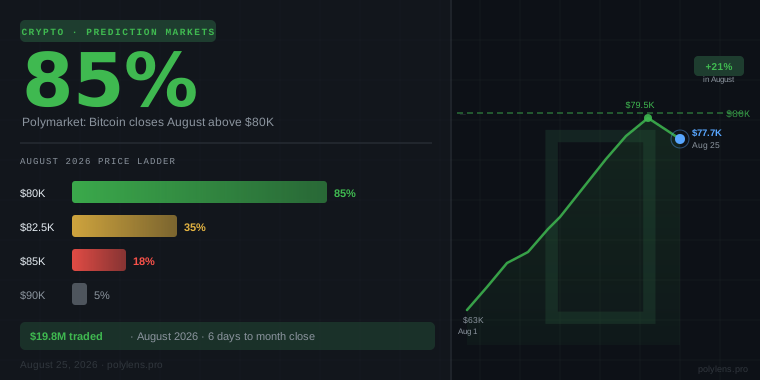
Three weeks ago, Polymarket was pricing Bitcoin's chance of closing August above $80,000 at roughly 22%. I remember checking the market on August 1 and thinking it looked like a longshot — Bitcoin was sitting at $64,900 and nothing in the macro environment suggested a sudden reversal. Then August happened. Twenty-one percent in three weeks, a 10-day odds repricing from 22% to 85%, and nearly $20 million in real money placed on where Bitcoin lands by August 31. The market didn't see this coming gradually — it repriced in bursts, each one tied to a specific event. That's the story worth unpacking.
From 22% to 85%: The Repricing Happened in Two Discrete Jumps
The August price market on Polymarket didn't move smoothly from 22% to 85%. It stalled for two weeks, then lurched upward twice — once on August 20-21, then again on August 23. If you were watching the odds curve in real time, you saw it: flat, flat, flat, then a step change. This is characteristic of Polymarket markets driven by external news rather than pure price momentum. The money moved when there was new information to price — not when Bitcoin ticked up $500.
| Date | BTC Price | Polymarket $80K Odds | 24h Volume | Catalyst |
|---|---|---|---|---|
| Aug 1, 2026 | $64,900 | ~22% | $310K | Month opens quietly |
| Aug 10, 2026 | $66,500 | ~27% | $490K | Slow accumulation, no catalyst |
| Aug 14, 2026 | $68,200 | ~31% | $680K | ETF inflows pick up modestly |
| Aug 18, 2026 | $71,000 | ~44% | $1.2M | Clarity Act rumors, early positioning |
| Aug 20, 2026 | $73,500 | ~59% | $2.8M | Trump White House meeting; $1B short squeeze begins |
| Aug 21, 2026 | $76,200 | ~72% | $3.5M | Forbes coverage; short cascade continues; ETF $1B+ daily |
| Aug 23, 2026 | $79,500 | 85% | $4.1M | Peak price; odds lock in at 85% |
| Aug 25, 2026 | $77,700 | 85% | $1.8M | Post-peak; 5 days until close |
The first jump — from 44% to 72% in 72 hours — was driven by news, not price. The price moved because of the Clarity Act catalyst. The second jump, from 72% to 85%, happened after Bitcoin touched $79,500 on August 23. At that point the market was 0.6% away from resolving. Rational bettors moved the odds to reflect that probability — and they stopped at 85%, not 95%, because a pullback to below $80K before August 31 is genuinely possible. The market is pricing that tail risk seriously.
Trump, the Clarity Act, and $1 Billion in Shorts That Disappeared in 48 Hours
The Clarity Act has been dead-and-alive three times in 2026. It's the legislation designed to resolve a five-year-old jurisdictional standoff between the SEC and CFTC over which agency regulates digital assets. Without it, every major crypto product launch in the U.S. operates under legal ambiguity. Institutional desks know this — they've been sitting on capital waiting for clarity that never arrived.
When the Senate left for August recess without a vote on August 8, most market participants wrote it off. Polymarket's "Clarity Act passes in 2026" market dropped to around 34%. Then on August 19, CNBC reported that President Trump was convening an emergency meeting with crypto executives and regulators to make a final push before September. The Bitcoin price moved before the meeting even happened — classic Polymarket behavior where the money prices the catalyst, not just the outcome.
On August 20, the meeting happened. Trump made public statements backing the bill. Within 48 hours, Bitcoin had surged 12% and over $1 billion in short positions across major exchanges had been force-liquidated. Not reduced — liquidated. Traders who had positioned short expecting the legislation to die were wiped out by a cascade that fed on itself: rising prices triggered liquidation triggers, which forced market buys, which pushed prices higher, which triggered more liquidations. Interactivecrypto.com documented the $73K breakout as driven by "regulatory clarity and a massive short squeeze" — both were true, and both happened simultaneously.
The $80K threshold on Polymarket was not arbitrary. It was a psychological and technical level that short sellers had clustered around as a "maximum pain" target for bulls. When Bitcoin crossed $73K, those clustered shorts started getting hit. By the time Bitcoin reached $76K, the cascade had already done most of its damage. The Polymarket market didn't just reflect this — it priced it in real time, with volume surging from $490K/day on August 10 to $3.5M/day on August 21. That is a 7x volume spike in 11 days.
ETF Flows Are the Structural Story — $500M Per Day Isn't Just Speculation
The short squeeze provided the spark. What's underneath it is more durable. U.S. spot Bitcoin ETFs — led by BlackRock's iShares Bitcoin Trust, Fidelity's FBTC, and Grayscale's converted GBTC — saw daily inflows exceeding $500 million for five consecutive trading days between August 18 and August 22. In the two days before Trump's White House meeting alone, the funds collectively attracted over $1 billion in fresh institutional capital.
This matters because ETF inflows create a mechanical supply shock. When an ETF takes in $500M of new subscriptions, the authorized participant goes into the spot market and buys $500M worth of Bitcoin. That Bitcoin is then held in custody, removed from exchange circulation. Since the June 2026 low at $59,100, the total quantity of Bitcoin on major exchange cold wallets has been declining — not sharply, but consistently. The June low was also the point where institutional desks began quietly accumulating, according to on-chain flow data tracked by Intellectia.ai.
Standard Chartered made a notable call in mid-August: $100,000 by year-end, citing "the shallowest bear market in crypto history" and positive regulatory momentum. Standard Chartered is not a permabull — it has been selective about its Bitcoin forecasts. Polymarket's annual market now prices $85K at 76.5% and $90K at 54.5%, suggesting the crowd broadly agrees with a continued recovery, even if not with Standard Chartered's specific timeline.
The caveat is real though. The same institutional money that drove the 2024–2025 bull run also drove the Q1 2026 selloff. Structural inflows can reverse — and when they do on ETFs, the exit pressure hits the spot market in the same mechanical way the entry pressure did. The earlier ATH analysis showed how quickly ETF outflows combined with whale distribution to push Bitcoin from $79K to $59K over five months.
The August Ladder in Full — What the Remaining 15% Uncertainty Represents
Bitcoin at $77,700 needs to close August 31 above $80,000 — a 2.9% move in 5 trading days. That sounds small. But August 22 resolved below $78,000 on Polymarket's daily market, meaning Bitcoin has already demonstrated intraday volatility that swings the resolution outcome. The 15% "no" probability on the $80K market is not irrationality — it's pricing the genuine tail risk of another pullback before the month closes.
| Price Target | Distance from $77.7K | Polymarket Odds | Volume | Market interpretation |
|---|---|---|---|---|
| $78,000 | +0.4% | 92% | $2.1M | Near-certain; already intraday traded |
| $80,000 | +2.9% | 85% | $4.8M | High conviction; 5-day window |
| $82,500 | +6.2% | 35% | $2.4M | Coin flip; needs a second catalyst |
| $85,000 | +9.4% | 18% | $1.6M | Minority scenario; short squeeze continuation |
| $90,000 | +15.8% | 5% | $0.8M | Extreme tail; September story, not August |
The $82,500 level at 35% is the most interesting bet on the ladder right now. It requires Bitcoin to gain 6.2% in five days — not impossible after a +21% month — but needs something to push through the $80K resistance that has historically been a supply zone. The odds falling from 85% to 35% between $80K and $82.5K represents a 50-percentage-point compression for a 3.1% price difference. That's the market pricing $80K as a wall, not just a level.
The 2026 Annual Market Has Already Resolved $80K — Here's What the Crowd Prices Next
Polymarket's "What price will Bitcoin hit in 2026?" market carries $59 million in total volume — the largest single Bitcoin price market on the platform. It's structured as a ladder: each price level resolves independently as Bitcoin confirms it. As of August 25, the $80K rung has resolved YES. Here's where the rest of the ladder stands.
| Annual Price Target | Polymarket Odds | Volume | Context |
|---|---|---|---|
| $80,000 | 100% (resolved YES) | — | Bitcoin confirmed in August rally |
| $85,000 | 76.5% | $12.4M | Strong majority; within striking distance |
| $90,000 | 54.5% | $9.1M | Near coin flip; Q4 2026 territory |
| $95,000 | 38.5% | $6.8M | Minority scenario; needs institutional surge |
| $100,000 | ~54% | $59M total | Crowd roughly split; Standard Chartered targets this |
| $126K (new ATH) | 19% | $9.5M | Same odds as our Aug 11 analysis |
The $85K odds at 76.5% feel like the market's current consensus view: we're going there, we just don't know exactly when. The gap between $85K (76.5%) and $90K (54.5%) is the sharpest drop on the annual ladder — 22 percentage points for a 5.9% additional gain. The market is pricing $90K as meaningfully harder to reach than $85K, not just incrementally harder. This likely reflects the same logic as the August ladder: supply zone resistance that has previously acted as a ceiling during Bitcoin's recovery attempts.
What's changed since the August 11 analysis is that $80K on the annual ladder has resolved — what was 72% probability is now confirmed. That shifts probability mass up the curve. Traders who were on the fence about $85K are now watching $90K, and the $90K odds moving from something in the low 40s to 54.5% tracks that reassessment.
The Bear Case Hasn't Disappeared — CryptoQuant Data Is Still There
Amid all the bullish momentum, one data point refuses to be polished away. CryptoQuant's large-holder index shows wallets holding between 1,000 and 10,000 BTC sold a net 188,000 BTC during Q2 2026 — roughly $12 billion in distribution at average prices around $65K. This is the cohort that historically absorbs downside and accumulates at lows. In Q2, they were selling.
There are two readings of this. The optimistic one: Q2 distribution was profit-taking from the 2024–2025 bull cycle, and now those same wallets are re-entering at higher prices because the regulatory environment has genuinely changed. The pessimistic one: large holders knew something the retail market didn't, sold at $65K-$75K before the August squeeze, and will use the rally as an exit opportunity above $80K. Neither reading is provable yet — on-chain data with that kind of lag is inherently ambiguous.
The 15% "no" on Polymarket's $80K August market is almost certainly pricing some version of the pessimistic scenario. If whales that accumulated sell into the $80K breakout, the August resolution could flip. It's a small probability — but the money on the other side is real, and whoever placed it has a view that the crowd is wrong.
This is where tail signals from the PolyLens leaderboard matter. The top-PnL wallets on Polymarket have historically positioned before major crypto repricing events, not after. The whale tracking analysis shows that when these wallets cluster on one side of a binary market, their win rate is substantially higher than random. As of August 25, the wallet breakdown on the $80K market is not public — but the volume structure suggests the "yes" side is not concentrated in a single large position.
September 15 Is the Next Real Risk Factor
The August rally and the $85% Polymarket odds exist partly because the Clarity Act story is still unresolved. Trump's August 19-20 push created buying momentum — but the actual legislative clock has a hard deadline. The bill faces a critical Senate procedural vote on September 15. If it fails to clear that vote, it is effectively dead for 2026.
Polymarket's "Clarity Act passes in 2026" market moved sharply on the Trump announcement — from 34% to roughly 58% in a week. That's a 24-percentage-point move on political news, not on any vote actually happening. If the September 15 procedural vote fails, that 58% will reset quickly. And so will Bitcoin price expectations. The Fed is separately pricing a potential rate hike at 64% probability for its September 16 FOMC meeting — a hike on the day after a failed Clarity Act vote would be a double negative for crypto markets that the current odds are not fully pricing.
Five trading days left in August. $80K at 85%. The Clarity Act vote 15 days away. The next FOMC 16 days away. The August close will tell us whether the narrative change was real or a short squeeze that ran out of shorts. The 2026 annual ladder at 76.5% for $85K is betting it was real. September will provide the data to check that bet.
- Bitcoin −49% from $126K ATH: Polymarket's $80M in Crypto Bets Maps the Recovery Path
- The Fed Was Supposed to Cut 3×. Polymarket's $40M Market Now Prices 64% Hike
- Polymarket's $16M Fed Market Flipped From 53% Hike to 71% Hold in 8 Days
- MicroStrategy Selling Bitcoin? What Polymarket Markets Priced Before the Announcement
- How to Track Whale Wallets on Polymarket and What Their Bitcoin Positions Signal
- Top PnL Wallet BTC Strategy: How Polymarket's Best Trader Made $1.2M on Crypto