CLARITY Act Dead at 49-50. Bitcoin −$1,600 in Three Hours. Polymarket's Fed Market at 88% for Tomorrow. Here Is the Full Scorecard.
September 15, 2026 · 14 min read
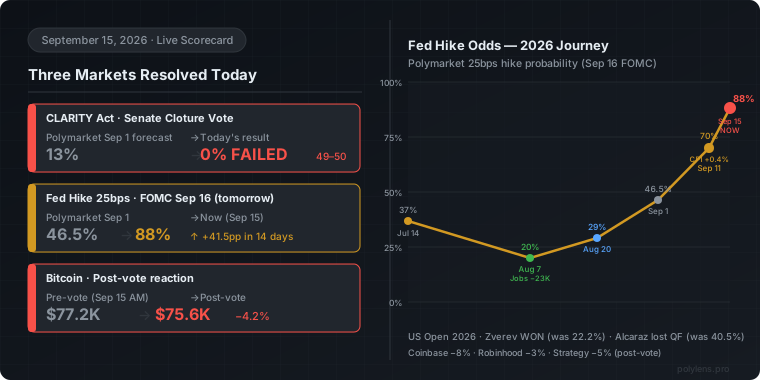
The vote came in at 2:15 PM Eastern time. 49-50 against cloture. The seven Democratic senators who had spent months negotiating the text — Gillibrand, Warner, Booker, Warnock, Gallego, Alsobrooks, Cortez Masto — all voted no. The bloc that was supposed to deliver seven votes delivered zero. Within twenty minutes, Bitcoin was trading $600 lower. Within three hours, it had fallen $1,600 from its pre-vote level.
Two weeks ago, this was the worst-case scenario with a 40% implied probability: CLARITY Act fails and the Fed hikes the following day. On September 1, we called it "the most dangerous 48 hours in crypto this year." That framing has aged well — uncomfortably well. The Fed decision tomorrow now sits at 88% probability of a 25 basis point hike on Polymarket. Here is every number from the past two weeks, and what it means for the next 24 hours.
49-50: The Seven Votes That Didn't Come and the Reason They Never Could
The cloture vote failed in the sharpest possible way. Not barely — not 57-43 where three more deals might have made the difference. 49-50, with the entire Democratic negotiating coalition voting no simultaneously. When you see that kind of synchronized reversal, it means the final draft still contained something that was a dealbreaker across the whole bloc, not a individual objection from one or two senators.
The dealbreaker was the same thing it had been since February: ethics provisions governing elected officials' crypto holdings. The CLARITY Act was designed as a market structure bill — resolving the SEC vs CFTC jurisdictional fight that has paralyzed institutional crypto for five years. That underlying framework had genuine Democratic support. What it never had was a solution to the political problem of a sitting president who disclosed $1.4 billion in crypto profits while the bill was being written. Every Democratic senator voting for a bill that directly benefits the president's personal portfolio needs a specific counter-argument for their constituents. The revised draft did not provide one.
Gillibrand — who had championed an earlier, more bipartisan predecessor bill for three years — was the most notable no vote. Warner and Booker had been involved in drafting sessions as recently as last week. Their unanimous rejection of the final text signals that the September 15 deadline produced a rushed bill that satisfied the crypto industry's substantive asks but failed the political test that Democratic senators needed to pass to their own voters. The math: Republicans 51 effective votes (Hawley and Paul voted against; two others were absent). Democrats needed: nine. Democrats delivered: zero.
Polymarket's "CLARITY Act signed into law in 2026" market is now trading at approximately 5%. That residual probability accounts for extremely unlikely scenarios — a lame-duck session deal after the November midterms, a presidential executive order that substitutes partial clarity for legislative certainty, or a court ruling that resolves the CFTC/SEC jurisdictional question without Congress. None of these is realistic within 2026. The 5% is prediction markets pricing "we cannot rule out black swans," not genuine legislative optimism.
Bitcoin at $75,600: The Market Priced the Failure Before the Vote Was Called
The Bitcoin price reaction today was front-loaded in a characteristic way. The actual vote at 2:15 PM ET was known to be likely to fail hours earlier — Senate vote count reports were circulating by early morning, and Polymarket's odds for passage had declined overnight from approximately 13% to under 10% before the vote even happened. Bitcoin had already given back Monday's overnight rally by 11 AM, trading at $76,862 as of the CoinDesk morning report. The post-vote drop from $77,200 to $75,600 represented the final leg of a move that had started the night before.
This is the Polymarket calibration story in compressed form. By September 1, the prediction market had CLARITY at 13%. By September 14, it was below 10%. The smart money was positioned before the vote announcement, not after it. Anyone who sold Bitcoin on the vote result at 2:15 PM was reacting to news that prediction markets had already priced at approximately 87-90% probability of failure. The incremental information in the vote outcome was worth roughly $600-800 of Bitcoin price movement — the gap from $76,862 (pre-vote) to approximately $75,600-76,000 (post-vote). The larger move from $77,200 to $76,862 happened overnight.
| Time / Event | Bitcoin Price | CLARITY Odds | Move |
|---|---|---|---|
| Monday Sep 14 close | ~$77,200 | ~13% | Post-weekend rally |
| Tuesday Sep 15, 9 AM ET | ~$76,862 | ~10% | Overnight reversal begins |
| Tuesday Sep 15, 1 PM ET | ~$76,400 | ~8% | Vote count leaks |
| Tuesday Sep 15, 2:15 PM ET | ~$76,200 | Vote: 49-50 | Bill fails cloture |
| Tuesday Sep 15, 5 PM ET | ~$75,600 | ~5% | −$1,600 from day's high |
| Tuesday Sep 15, low (intraday) | <$75,000 | — | Briefly below $75K support |
Coinbase fell 8.3% on the session, Robinhood 3.1%, and Strategy (the company formerly known as MicroStrategy) 5.2%. The crypto equity selloff was proportionally larger than the Bitcoin spot move — a pattern that has recurred throughout 2026 whenever regulatory risk materializes. Equity holders cannot easily hedge against legislative outcomes the way spot traders can, so the options market on Coinbase had been pricing elevated implied volatility for September 15 since early September. That vol got realized.
The Fed Market: 46.5% to 88% in 14 Days — August CPI Was the Break Point
On September 1, this platform published a piece showing Polymarket pricing the September 16 Fed hike at 46.5% against CME FedWatch's 60.4% — a 13.9-point divergence that we flagged as historically unusual. Both markets were right that a hike was more likely than not. Neither was pricing 88%.
The move from 46.5% to 88% happened in two steps separated by 10 days. The first step was the August CPI report released on September 11: headline inflation rose 0.4% month-on-month (versus 0.1% in July — the largest monthly acceleration in four months). Core CPI came in at 0.3% monthly. The market had been pricing a benign 0.2-0.3% monthly read as the base case. At 0.4%, the trajectory of inflation was no longer pointing toward the Fed's 2% target — it was pointing away from it.
The second step was the CLARITY Act failure itself. Counterintuitively, a crypto regulatory failure tends to be slightly hawkish for rate markets, not dovish. The reasoning: failed crypto regulation reduces institutional capital flows into digital assets, which reduces demand for risk assets broadly, which tightens financial conditions — which means the Fed needs to do slightly less work to achieve the same effect. This is a second-order effect and accounts for perhaps 2-3 percentage points of the 88% number. The August CPI was the primary driver, accounting for roughly 20-25 points of the move from 46.5%.
| Date | Fed Hike Odds (25bps) | Event | Move |
|---|---|---|---|
| July 14, 2026 | 37% | Baseline pre-July meeting | — |
| August 7, 2026 | 20% | July jobs: −23,000 (dovish shock) | −17pp |
| August 20, 2026 | 29% | Recovery from jobs shock | +9pp |
| August 28, 2026 | 46.5% | Warsh Jackson Hole: "work to do" | +17.5pp |
| September 11, 2026 | ~70% | August CPI: +0.4% monthly (hot) | +23.5pp |
| September 15, 2026 | 88% | CLARITY Act failure + positioning | +18pp |
The September 11 CPI data was the single most important variable in the entire September 16 FOMC market — as we identified it would be on September 1. When monthly headline CPI doubles in one month (July: +0.1% → August: +0.4%), the market has no logical basis for pricing a hold at the same meeting where the chair explicitly said he had "work to do" at Jackson Hole two weeks earlier. The hike was becoming a near-certainty from September 11 onward; the question was how much the final odds would move.
From 88%, the residual 11% probability on "no change" can be interpreted as: a non-trivial chance that Warsh surprises with dovish language in the statement, or that one or two more dissenters than expected vote against the hike and the press conference softens forward guidance enough that the initial 25bps is treated as a one-and-done. Polymarket rarely drives to 95%+ on Fed decisions even when the direction is nearly certain — there is always a tail probability that the Fed communication reversal is possible.
The September 1 Scenario Matrix: The Worst Case Was the Base Case
Two weeks ago, the four-scenario analysis produced the following implied probabilities using Polymarket's prices at the time. Here is that matrix with the September 15 outcomes filled in:
| Scenario | Sep 1 Implied Prob. | Sep 15 Status | Bitcoin Impact |
|---|---|---|---|
| Best case: CLARITY Pass + Fed Hold | 7.0% | Not happening | $85K–90K scenario gone |
| Mixed: CLARITY Pass + Fed Hike | 6.0% | Not happening | — |
| Mixed: CLARITY Fail + Fed Hold | 46.5% | Unlikely | $72K–77K scenario |
| Worst case: CLARITY Fail + Fed Hike | 40.4% | Playing out | $65K–71K risk |
The worst-case scenario was the modal prediction of the market two weeks ago. The 40% was not a tail risk — it was the single highest-probability scenario in the matrix. The market was telling us: expect this. And the market was correct.
What is notable is that the independence assumption in the matrix was also partially validated. CLARITY Act failure and Fed hike occurred as correlated events but not as causally dependent ones. The CLARITY failure happened because of Senate ethics politics (independent of the Fed). The Fed hike became likely because of August CPI (independent of CLARITY). They converged on the same 48-hour window by historical accident, not causal linkage. Prediction markets priced both as approximately independent binary outcomes — and both resolved in the same direction.
The residual question: does Bitcoin actually trade to $65K–71K, or does it hold the $75K level? The scenario matrix estimated the Bitcoin impact assuming the worst case materialized. We are in that worst case. Bitcoin has not yet found the floor of that range — $75,600 is above $71,000. But the Fed decision tomorrow at 88% hike probability is not yet priced into the spot market in full. If Warsh hikes 25bps tomorrow and provides hawkish forward guidance (indicating October is also live), the move to the lower end of the $65K–71K range becomes more probable than it appeared on September 1.
US Open Postmortem: How Polymarket Got Zverev Wrong at 22.2%
The US Open resolved on September 13 with a result that Polymarket's pre-tournament pricing consistently underestimated. Alexander Zverev won, beating Ben Shelton 6-3, 7-6(2), 5-7, 6-2 in the final. Carlos Alcaraz — the 40.5% favourite — lost in the quarterfinals to Shelton, 6-7, 5-7, 6-1, 6-3, 1-6, 7-6(7), a marathon that ended at 3:33 AM local time in one of the most dramatic matches of the tournament.
| Player | Pre-Tournament Odds | Sep 3 Odds | Final Odds | Result | Accuracy |
|---|---|---|---|---|---|
| Carlos Alcaraz | ~28% | 40.5% (peak 43%) | ~0% (QF exit) | QF loss to Shelton | Heavy overpricing |
| Alexander Zverev | ~21% | 22.2% | 51% (pre-final) | WON | Significantly underpriced |
| Ben Shelton | ~5.5% | 8.2% | ~49% (pre-final) | Runner-up | Correctly directional |
| Taylor Fritz | 2.9% | 7.9% | ~0% (QF exit) | QF loss | Neutral |
The Alcaraz mispricing was systematic, not random. The market applied a "defending champion narrative" premium that outweighed the base rate for injury comeback performances. Alcaraz had been off the tour for over four months with a wrist injury. His first tournament back was the US Open itself — no tune-up events, no competitive match data to update the prior. The 40.5% market price was built primarily on Alcaraz's 2024-2025 track record and the Djokovic-elimination path benefit, neither of which accounted for the fitness deficit that a 3:33 AM marathon quarterfinal would expose.
Zverev at 22.2% — less than half Alcaraz's probability — was the more interesting mispricing. His 2026 record at grand slams was objectively the best in the field: 18-2, Roland Garros champion, Wimbledon finalist. The discount likely reflected Polymarket's crypto-native user base being less familiar with tennis-specific form analysis and more susceptible to narratively salient pricing (Alcaraz comeback story) than objectively calibrated probability. The crowd corrected toward Zverev as the tournament progressed — he was 51% before the final — but the pre-tournament number was 28-29 percentage points too low relative to his eventual win frequency.
For prediction market traders, the actionable lesson from the US Open is: in sports markets with rich recent form data on multiple players, Polymarket tends to overweight narrative salience (comeback, defending champion) relative to objective statistical indicators. The World Cup accuracy analysis from July showed a similar pattern — Spain's structural form metrics were underpriced relative to their 59% final odds, but that final odds figure was closer to fair than the US Open's Alcaraz/Zverev gap. Sports markets appear to have a persistent narrative-salience bias that corrects slowly.
What 88% Fed Hike Tomorrow Actually Means for the Next Two Weeks
The 88% number on Polymarket captures the decision itself. What it does not capture is the forward guidance that Warsh will deliver in the press conference at 2:30 PM ET tomorrow. This is where the real information is — not in the 25bps that the market has already priced, but in whether Warsh signals that one hike resolves the problem or whether he flags October as a live meeting.
If the statement reads "one and done" — implying no further hikes are currently expected — then the initial market reaction to the hike will be muted or positive. Crypto markets could recover toward $78K-$80K. The CLARITY Act failure has already been discounted. A dovish Fed hike is a net positive relative to what is currently priced. This scenario would require Warsh to essentially say: we needed to respond to August CPI, but the data trajectory remains toward target.
If the statement reads "ongoing monitoring required" — the standard hawkish hedge language — then October becomes live at roughly 30-40% probability, and the second leg of the bearish scenario extends. Bitcoin at $75,600 would be testing support rather than bouncing. The $71,000 level — which has been referenced in this and earlier analyses as the bottom of the worst-case range — becomes relevant.
Polymarket has no clean market on "dovish vs hawkish forward guidance" as a binary — this is a limitation of how the September 16 market was structured. The signals feed will be watching the FOMC statement closely for the specific phrase patterns that predict further hikes. The Telegram bot will push alerts on odds movements in the crypto price markets (Bitcoin $70K, $75K, $80K) that will effectively price the guidance tone in real time after the press conference.
CLARITY Act: Dead for 2026, and What the 5% Residual Is Pricing
The Polymarket market for "CLARITY Act signed into law in 2026" now trades at approximately 5%. That number will likely drift toward 2-3% over the coming weeks as the legislative calendar becomes definitive. The Senate has approximately 22 working days remaining before midterm campaigning takes over the schedule in mid-October. None of those days will include a second attempt at a bill that just failed 49-50 with zero Democratic crossover.
The 5% is not zero for three reasons. First, a presidential executive order that directs the SEC and CFTC to implement joint rulemaking on digital asset jurisdiction — without requiring legislation — is theoretically possible and would partially satisfy the market's underlying demand for clarity. This path has constitutional challenges but has been used in adjacent regulatory areas. Second, a lame-duck session after the November midterms represents a window: senators who lose their seats in November have less political incentive to worry about the crypto ethics optics. Third, a court ruling in one of the pending SEC enforcement cases could establish de facto jurisdictional clarity that makes the CLARITY Act partially redundant.
None of these paths is likely. But "not likely" and "5% probability" are consistent statements in a prediction market. The more interesting question for crypto markets is whether the 2027 legislative calendar, with a potentially different Senate composition after the midterms, creates a realistic path. Polymarket's "CLARITY Act passed in 2027" market does not yet exist, but when it opens — likely after the November election — it will tell us whether the crowd thinks this was a setback or an ending.
Fourteen months of effort, $11.5 million traded on the outcome, and seven Democratic senators who spent months negotiating a bill they ultimately could not vote for. Bitcoin at $75,600, waiting for Warsh at 2:00 PM tomorrow. The worst-case scenario landed exactly where the probability said it would. Now we find out how the Fed chooses to explain a decision that has been certain for four days.
- September 1: CLARITY Act 13% + Fed Hike 46% — The Original Risk Map
- US Open Accuracy: Djokovic at 55% vs Sportsbooks' 85%, Alcaraz Overpriced at 40.5%
- $20M on Bitcoin's August — The Clarity Act Catalyst That Drove the August Rally
- The Fed Was Supposed to Cut 3×. Polymarket's $40M Market Now Prices 64% Hike
- Bitcoin −49% from $126K ATH: Polymarket's $80M Recovery Path Map
- 2026 Midterms: Democrats 88% House, Republicans 55% Senate — Now $133M in Volume