CLARITY Act at 13%, Fed Hike at 46% — Polymarket's $80M Bet on the Most Dangerous 48 Hours in Crypto This Year
September 1, 2026 · 14 min read
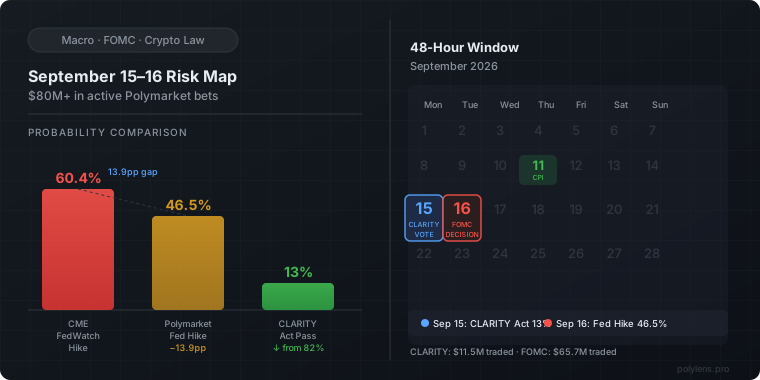
In February, I had the CLARITY Act market pulled up next to my Polymarket feed with 82% odds. It felt like a formality — the bill had bipartisan momentum, Senate Majority Leader had scheduled floor time, and crypto markets were pricing in a regulatory clarity premium that had pushed Bitcoin through $90K. That 82% is now 13%. And the Federal Reserve meets the day after the final Senate vote. This is an extraordinary coincidence of timing, and I don't think prediction markets are fully pricing the interaction between the two events.
Fourteen days until the most consequential 48-hour window crypto markets have seen in 2026. More than $80 million in real money is riding on the outcomes. Here is every number that matters, where the platforms disagree, and what the divergence actually means for anyone positioned in these markets.
Warsh Said "Work to Do." CME Heard a Hike. Polymarket Wasn't Fully Convinced.
Kevin Warsh's August 28 address at Jackson Hole lasted 42 minutes. The paragraph that moved markets was about 60 words long: he said inflation's underlying trends had not meaningfully improved, that the Fed's 2% target remained non-negotiable, and that the institution "may have more work to do." In Fed speak, "work to do" means rate hikes. The futures market understood immediately.
CME FedWatch, which aggregates positioning in fed funds futures, jumped from roughly 55% hold probability to 60.4% hike probability within hours of the speech. That is a 5-percentage-point move on a single speech — unusual but not unprecedented for a Jackson Hole keynote. The last time markets moved this sharply on Warsh's communication was after the June dot-plot update, when three dissenters voting for a hike at the July 29 meeting sent the "zero cuts in 2026" Polymarket market from 78% to 88.8%.
Polymarket moved too — but less. The Fed September hike contract on Polymarket went from approximately 43% pre-speech to 46.5% as of September 1. The gap between CME FedWatch (60.4%) and Polymarket (46.5%) is now 13.9 percentage points. That is not rounding error. That is a genuine disagreement between two markets with real money on both sides.
| Platform | Hold (No Hike) | Hike 25bps | Total Volume | 24h Volume |
|---|---|---|---|---|
| Polymarket | 53.5% | 46.5% | $65.7M | $2.4M |
| Kalshi | 68–70% | 30–32% | ~$18M est. | — |
| CME FedWatch | 39.6% | 60.4% | n/a (futures) | — |
| SOFR Futures | ~68% | ~32% | n/a | — |
The Kalshi number is the outlier in the other direction — 68–70% hold is considerably more dovish than Polymarket's 53.5%. This creates an arbitrage-adjacent situation where Kalshi and CME FedWatch are almost mirror images of each other, with Polymarket sitting in between. Whoever is right will have a very good week on September 16.
The data Warsh was citing is real. Core PCE inflation on a 6-month annualized basis is running at 4.1% — faster than the 3.7% on a 12-month basis. When the short-term trend runs hotter than the long-term trend, it means inflation is accelerating right now, not decelerating. Warsh knows this. The bond market knows this. The only people who seem less certain are Polymarket's prediction market traders, who have repeatedly underpriced Fed hawkishness throughout 2026.
CLARITY Act: From 82% in February to 13% — What Happened in Seven Months
The collapse in CLARITY Act odds is one of the more brutal repricing events in Polymarket's history. To go from 82% to 13% on a single market with $11.5 million in volume is a $7.9 million implied loss for "yes" holders — and that is assuming perfect mark-to-market. The actual PnL of individual traders depends on when they entered, but the directional move has been relentless and one-way.
The odds history is a case study in Senate math making itself understood, slowly and then all at once. In February, when the bill had just passed committee and the new administration was publicly backing it, 82% felt earned. The Clarity Act had genuine bipartisan support — or so it appeared. Then the details emerged.
| Date | CLARITY Odds | Catalyst / Context |
|---|---|---|
| February 2026 | 82% | Committee passage, bipartisan optimism, Bitcoin at $90K+ |
| April 2026 | 65% | Senate scheduling delays; procedural fights with Democrats |
| June 2026 | 55% | Senate recess risk; World Cup distraction; no floor date set |
| August 8, 2026 | 34% | Senate left for August recess without a vote |
| August 19–20 | 58% | Trump White House meeting with crypto executives; emergency push |
| August 28, 2026 | ~22% | Senate vote count leaked — 8 Democrats confirmed "no" |
| September 1, 2026 | 13% | $818K whale bet against passage; ethics fight escalating |
The August 19–20 rally from 34% to 58% was entirely driven by Trump's intervention. The White House meeting with crypto executives produced strong public statements but no new Senate votes. When the actual count leaked the following week — eight confirmed Democratic "no" votes in a chamber where you need nine — the odds fell back through 34% without stopping. The $818K wallet that bet against passage opened its position on August 29, one day after the leaked count. That is not random timing.
The 13% odds are not zero, and that matters. A 13% probability in a prediction market with real money means traders with actual skin in the game believe there is a meaningful chance the bill passes. The 13% is pricing three possible paths: procedural deals that restructure the bill to attract Democratic votes, a last-minute concession on the crypto ethics disclosure issue, or a split-bill strategy that separates the CFTC jurisdiction provisions from the more controversial SEC elements. Any of these could theoretically produce a 60-vote coalition in 14 days.
That said, the market has been wrong before in the optimistic direction on this bill. The 82% to 13% collapse represents real information arriving about real Senate math, not just sentiment. The people betting at 13% are betting on a process miracle, not on a fundamentally different reading of the vote count.
September 11 CPI Is the Variable That Resolves the Fed Divergence — Five Days Before Everything Matters
The last major data print before both September 15 and September 16 is the Consumer Price Index release scheduled for September 11. Five days before the CLARITY Act vote. Five days before the FOMC meeting. Every basis point in that print will move the Fed hike odds, and by extension the CLARITY Act odds (since a hawkish Fed is generally negative for crypto sentiment, which affects how the market values regulatory clarity).
The June CPI at 3.4% was the single biggest repricing event in the Fed September market — it added approximately 10 percentage points to the hold probability in one day, according to the August 20 analysis. The July jobs data at -23K was even bigger, adding 17 percentage points to hold in a single session. September 11 CPI will carry that same weight, potentially more, because the meeting is now days away rather than weeks.
The base case: core CPI around 3.5–3.7%, consistent with the most recent prints. At that level, the existing divergence between CME FedWatch and Polymarket probably narrows — both converge toward 50-50 — and the September 16 decision becomes genuinely uncertain. The hawkish case: core CPI above 3.8%. At that point CME FedWatch could push above 70% hike, and Polymarket's 46.5% would have to reprice sharply. The dovish case: core CPI below 3.3%. That is the scenario where Polymarket's dovish read turns out correct, hold odds surge, and the Fed hike narrative collapses for September.
The complication is that even a benign CPI print doesn't change the CLARITY Act vote count. The Senate math is what it is. What CPI affects is how much the crypto market cares about the CLARITY Act outcome — because in a tight-money environment where Bitcoin is already under pressure from rate hike fears, the incremental damage from failed legislation is amplified.
The Four Scenarios for September 16, Ranked by Crypto Impact
Two binary outcomes — CLARITY Act pass/fail and Fed hold/hike — produce four scenarios. Using Polymarket's current pricing (13% CLARITY pass, 46.5% Fed hike), the implied probability of each scenario is straightforward multiplication, with the assumption of independence between the two events.
| Scenario | CLARITY | Fed | Implied Prob. | Crypto Direction | BTC Est. |
|---|---|---|---|---|---|
| Best case | Pass ✓ | Hold ✓ | 7.0% | Strongly bullish | $85K–90K |
| Mixed — regulatory win | Pass ✓ | Hike | 6.0% | Mildly bullish | $78K–82K |
| Mixed — macro win | Fail | Hold ✓ | 46.5% | Mildly bearish | $72K–77K |
| Worst case | Fail | Hike | 40.4% | Double negative | $65K–71K |
The crowd is pricing the worst-case scenario — CLARITY Act fails and the Fed hikes — at 40%. That is more than twice the probability of the best case (7%). If you had to assign a modal outcome to September 16, it is currently "CLARITY fails, Fed holds" at 46.5% — a mildly bearish result that is not catastrophic but is disappointing relative to the market's February expectations.
The independence assumption in that matrix is worth questioning. CLARITY Act failure tends to create crypto bearishness which shifts Polymarket's crypto-native user base toward pricing dovish monetary policy — because bulls need the Fed to cooperate if the regulatory story has just collapsed. This means the two outcomes are probably negatively correlated from a market psychology standpoint: CLARITY fail makes Polymarket more likely to price a Fed hold, which understates the true hike probability if you think CME FedWatch is the better signal. The actual worst-case implied probability may be lower than 40% on the correlation-adjusted basis, but the dollar damage in that scenario is higher.
Why the Polymarket Crowd Is More Dovish Than CME FedWatch — And Whether That's a Signal
This is the question I keep coming back to. Every time the Fed has moved in 2026, the prediction market crowd on Polymarket has underestimated the hawkishness. The July 29 meeting resolved with three dissenters for a hike — more aggressive than the Polymarket consensus heading into that meeting. The June dot-plot update was more hawkish than Polymarket priced. Jackson Hole is now hawkish again, and Polymarket is again less certain than CME FedWatch.
There are several defensible explanations for the pattern.
The first is selection bias in Polymarket's user base. Polymarket traders skew heavily toward crypto investors, and crypto investors have a rational preference for loose monetary policy — lower rates are good for risk assets, including digital assets. This creates structural downward pressure on hike probabilities that is not a forecast error, just a reflection of who is betting and what they're hoping for.
The second explanation is that Polymarket's price discovery on macro markets improves dramatically in the final 7–10 days before a decision. The August 20 analysis showed the entire repricing from 53% hike to 71% hold happened in 8 days around the July jobs data. The prediction market is not setting price for 14 days out the same way it sets price for 2 days out. What looks like a divergence from CME FedWatch may simply be noisier long-range signal.
The third is that Polymarket traders have correctly identified something in the data that CME FedWatch hasn't priced: the political pressure on Warsh not to hike. Trump has been publicly and repeatedly demanding lower interest rates throughout 2026. If Warsh hikes in September over explicit Presidential objection, he would be accelerating a constitutional confrontation over Fed independence. Some Polymarket traders may be pricing a small but real probability that Warsh blinks for political reasons, even if his economic analysis points to a hike.
That historical track record is genuinely interesting. Polymarket has outperformed CME FedWatch on Fed decisions so far in 2026 — three correct forecasts versus CME's three misses. But all three correct forecasts were in the same direction: Polymarket correctly priced holds that CME thought were closer to coin-flips. The dataset shows Polymarket is better at pricing holds, not that it is better at pricing hikes. September is the first meeting where the base case is arguably a hike. The historical advantage may not transfer.
The $818K Bet Against the CLARITY Act — Forensics of the Largest Single Position
A wallet opened a $818,000 position betting against CLARITY Act passage on August 29, the day after the leaked Senate vote count showed eight confirmed Democratic "no" votes. This is not a small retail bet — it is one of the top-five largest single positions ever placed on the CLARITY Act market. The wallet was new, with no prior activity on Polymarket, which is consistent with a large off-chain holder who had been monitoring the market and chose to enter after the vote count news.
The position sizing tells a story. At 13% odds, a $818,000 "no" position wins approximately $109,000 if the bill fails — a 13.3% return. That is not a high-return bet; it is a high-conviction, low-volatility position from someone who believes the 13% "yes" probability is substantially overstated. If the true probability of passage is 5% rather than 13%, the "no" position is priced to return roughly 5.6% (from the 94.7¢ implied by 5% → +$62K on $818K). At any probability below 13%, the position makes money.
For context: the top-PnL wallets tracked by PolyLens Leaderboard rarely place single positions above $500K on binary outcomes. An $818K position from a new wallet is unusual. It does not automatically mean informed — large positions from new wallets also appear in markets before incorrect outcomes — but the timing (one day after the vote count news) and the positioning (against the bill, not for it) suggest this is not a retail punter with a hunch.
Zero Cuts, Zero CLARITY, 46.5% Hike — The 2026 Monetary Policy Picture Is Not What Anyone Expected
It is worth stepping back to remember what Polymarket was pricing in January 2026. Three rate cuts by year-end. CLARITY Act at 82%. Bitcoin near $110K. The cumulative repricing over nine months is not just about prediction market accuracy — it is about how radically different 2026 turned out to be from the market consensus at the start of the year.
Polymarket's "zero Fed rate cuts in 2026" market now prices 88.8% probability. In January, that same outcome was priced at roughly 12%. That 76-percentage-point swing in a nine-month period represents a fundamental reassessment of the macro environment, driven by the May CPI shock (4.1% core, annualized), the July 29 FOMC's three dissenters, and Warsh's increasingly hawkish communication style.
The CLARITY Act collapse from 82% to 13% is a parallel story. Both were January consensus positions. Both have been serially repriced downward throughout the year. Bitcoin at $77,700 — down from $126K ATH in January — reflects the cumulative impact of both repricing events. The ATH odds analysis from August 11 showed the $126K ATH at only 19% by December, and that was before Warsh's Jackson Hole speech.
The August Bitcoin rally to $79,500 created temporary optimism that CLARITY Act would pass and the Fed would hold. That optimism is now being stress-tested in real time. The August 25 article noted September 15 as the "next real risk factor" — and here we are, two weeks out, with the risk fully visible in the odds.
What Warsh's Track Record Tells Us About September 16
Kevin Warsh has chaired four FOMC meetings in 2026: January, March, May, and July. He held rates at all four, despite increasingly hawkish rhetoric and three dissenters at the July meeting. The pattern suggests Warsh is willing to signal hawkishness through communication before acting — a "telegraph then execute" approach. Jackson Hole on August 28 was the strongest language he has used. The question is whether September 16 is where the communication finally converts into action.
The case for a September hike: core PCE accelerating on a 6-month basis, three dissenters at July already calling for a hike, Jackson Hole language explicitly citing "more work to do," and Warsh's 2% target language that leaves no ambiguity about direction. CME FedWatch at 60.4% reflects this case.
The case against: the July jobs print was -23,000 (unexpected contraction), which is not consistent with a labor market that needs cooling via higher rates. Warsh has shown preference for data dependency over calendar dependency — and the September 11 CPI is the data he will cite in the statement regardless of which direction it points. Political pressure from the administration, while not formally relevant to FOMC votes, has historically influenced the pace of communication even if not the votes themselves.
There is also a third scenario that prediction markets have largely ignored: a 25bps hike announced as explicitly conditional — "one and done" language signaling no further hikes in October. That would allow Warsh to respond to the accelerating inflation data while managing the market reaction. Polymarket has no market for "hike with dovish forward guidance" versus "hike with hawkish forward guidance." It is a binary, and the binary does not capture this nuance.
13% Is Not Zero — The Three Paths Where CLARITY Passes Anyway
Prediction markets treat 13% as a meaningful probability, not a rounding error. The implicit question is: what specific scenario produces a "yes" outcome from here?
Path one: procedural deal. The Senate Majority Leader could negotiate a modified cloture agreement that lowers the effective threshold — a time agreement or unanimous consent procedure — that effectively allows the bill to advance with fewer than 60 votes. This is rare but not impossible in the final days before recess when all parties want to leave town.
Path two: ethics carve-out. The core Democratic objection to the CLARITY Act is its ambiguity around presidents and senior officials holding crypto assets. A last-minute amendment explicitly excluding presidential crypto holdings from the regulatory framework being created — essentially addressing the $1.4B conflict-of-interest concern directly — could unlock two to three additional Democratic votes. Whether that is enough to reach 60 remains uncertain.
Path three: split the bill. The CFTC versus SEC jurisdictional question — who regulates Bitcoin, who regulates tokens — is less politically controversial than the personal conflict issues. A stripped-down version addressing only CFTC/SEC jurisdiction might attract broader support. It would be a diminished version of CLARITY, but it would resolve years of legal ambiguity for spot markets and derivatives.
The 13% is pricing the weighted average of all three paths succeeding, discounted by probability. None of them has better than a 30% individual chance. But collectively, they create just enough optionality that sophisticated bettors are not pricing the bill at zero.
Bitcoin at $77,700 on September 1 has already priced in a meaningful amount of pessimism about both outcomes. The $80K level held by the August close resolves the monthly Polymarket market as "yes," but the September outlook is fundamentally different from August's. August was a story about momentum and short squeezes. September is a story about two discrete binary events that will determine whether the momentum continues or reverses. The 40% implied probability of the worst-case scenario is sitting there, in the open, and the market is choosing how to position around it. Fourteen days to find out who had the better read.
- Polymarket's $16M Fed Market Flipped From 53% Hike to 71% Hold in 8 Days — All the Data Before September 16
- The Fed Was Supposed to Cut 3×. Polymarket's $40M Market Now Prices 64% Chance of a Hike Instead
- $20M on Bitcoin's August — Polymarket Odds Hit 85% on $80K. Here's What Actually Moved the Market.
- Bitcoin −49% from $126K ATH: Polymarket's $80M in Crypto Bets Maps the 2026 Recovery Path
- Polymarket Is Raising $1B at $20 Billion. Here's Why It's Worth Half of Kalshi.
- How to Track Whale Wallets on Polymarket and What Their Positions Signal