Polymarket's $16M Fed Market Flipped From 53% Hike to 71% Hold in 8 Days. Here Is Every Data Point That Moved It — and What Still Matters Before September 16.
August 20, 2026 · 9 min read
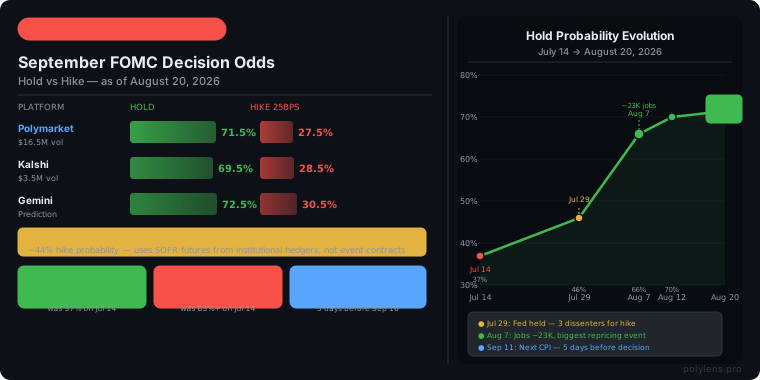
On August 1, 2026, this market had a simple story: the Federal Reserve was going to raise rates at its September meeting. Polymarket priced a 53% probability of a 25-basis-point hike — a majority consensus on Polymarket, and significantly above CME FedWatch's 32% implied probability. That divergence between prediction markets and traditional futures was widely reported as a contrarian signal.
Nineteen days later, the story is completely different. Polymarket now shows 71.5% probability of a hold at the September 15-16 meeting, with hike odds collapsed to 27.5%. Two data releases — the July jobs report on August 7 and the July CPI on August 12 — erased 35 percentage points of hike probability in a single week. The market that was majority-hike in early August is now majority-hold by a wide margin.
What makes this repricing important is not just the direction — it is the order of events. The jobs report moved the market more than the inflation data did. That inversion tells you something specific about how the Federal Reserve's reaction function has shifted in 2026, and why the September 11 CPI release — arriving just five days before the FOMC decision — is now the single most consequential piece of data remaining.
Three Platforms, Three Different Answers — and What the Gaps Actually Mean
The September 16 FOMC decision is one of the most-traded prediction market events of 2026: over $43 million has been wagered across Polymarket, Kalshi, and Gemini Markets, making it the second-highest-volume individual event on prediction markets this month. Yet despite this liquidity, the three major platforms — and CME FedWatch — show meaningfully different probabilities:
| Platform | Hold (no change) | Hike 25bps | Hike 50bps+ | Cut | Volume | Participant base |
|---|---|---|---|---|---|---|
| Polymarket | 71.5% | 27.5% | 4.5% | 0.5% | $16.5M | Global retail + crypto-native |
| Kalshi | 69.5% | 28.5% | — | — | $3.5M | US retail + institutional |
| Gemini | 72.5% | 30.5% | — | — | Est. $2.5M | Crypto-adjacent retail |
| CME FedWatch* | ~56% | ~44% | — | — | $billions | Institutional hedgers, banks |
*CME FedWatch derives probabilities from 30-Day Federal Funds futures — structured differently from event contracts and reflecting institutional hedging demand, not pure directional bets.
The 16-17 percentage-point gap between CME FedWatch (~44% hike) and Polymarket/Kalshi (~27-28% hike) is not a simple arbitrage — it reflects structural differences in who participates in each market and what incentives they have. CME participants are predominantly institutional traders hedging rate exposure on existing bond portfolios. Their futures prices reflect hedging demand rather than pure probability estimates. Prediction market participants have no hedging motive; their contracts pay out only if the event occurs, making them cleaner probability signals.
The August 7 Jobs Report Was the Biggest Single Repricing Event — Bigger Than CPI
Tracking the hold probability from July 14 through August 20 reveals a non-obvious pattern: the labor market data moved the September FOMC market more than the inflation data did.
| Date | Event | Key Reading | Hold Probability Before | Hold Probability After | Change |
|---|---|---|---|---|---|
| July 14 | June CPI release | Softer than expected | ~37% | ~43% | +6pp |
| July 29 | FOMC decision (held) | 3 dissenters for hike | ~43% | ~46% | +3pp |
| Aug 7 | July jobs report | −23K payrolls | ~49% | ~66% | +17pp |
| Aug 12 | July CPI release | 3.4% YoY (–0.1pp vs Jun) | ~60% | ~70% | +10pp |
| Aug 20 | Current (no new data) | — | 71.5% | Drift +1.5pp | |
The August 7 jobs report — showing a net loss of 23,000 payrolls in July — produced the largest single-session repricing of the September cycle. Hold probability jumped 17 percentage points in one session. The July CPI on August 12, by contrast, added 10 percentage points — significant, but secondary to the labor market shock.
This ordering reveals the Fed's current reaction function. In 2024 and early 2025, inflation data was the dominant driver of rate expectations. Now, with CPI hovering between 3.4-4.1% and the Fed already at 3.5-3.75%, the pivot point is employment. A Fed that is willing to hike further into a softening labor market is a hawkish Fed that needs political cover. The three dissenters from the July 29 meeting — who voted to hike when the committee held — represent exactly that hawkish minority. But even they would struggle to justify a hike when the economy is actively shedding jobs.
What the Three Dissenters Mean — and Why the September 11 CPI Is the Last Real Variable
At the July 29 FOMC meeting, the committee voted to hold rates at 3.5-3.75% — but three members dissented, arguing the committee should have raised rates immediately. This level of internal dissent is unusual: the last time three members dissented in favor of a hike at a hold meeting was 2023. It tells you the committee is genuinely divided, and that the September meeting is not a formality.
The three dissenters are not going to change their minds without evidence that the labor market is recovering. But they might be joined by one or two additional hawks if the September 11 CPI comes in above expectations. The September CPI — which covers August price levels and arrives just five business days before the FOMC statement — is the data release the market is effectively betting on when it prices the September hike at 27.5%.
| September 11 CPI Scenario | YoY Reading | Estimated Effect on Hike Odds | Expected FOMC Outcome |
|---|---|---|---|
| Downside surprise (dovish) | <3.2% | 27.5% → ~10-15% | Hold near-certain |
| In-line (consensus 3.3%) | 3.3% | 27.5% → ~25% | Hold majority consensus |
| Slight upside surprise | 3.5–3.7% | 27.5% → ~40-50% | Coin-flip repricing |
| Hot print (hawkish) | >3.8% | 27.5% → ~65%+ | Hike likely |
The table above is the core trade structure for the next 27 days. The in-line scenario is the most likely outcome — consensus expects September CPI around 3.3% — and in that case, Polymarket's current 27.5% hike probability is approximately correct. The asymmetry is significant: a hot CPI print (+2pp above consensus) pushes hike odds to 65%, a 37-percentage-point jump from current levels. A dovish CPI (-1pp below consensus) pushes them to 10-15%, a 12-17-point move. The upside shock moves the market more than the downside shock, which means buying the hike contract at 27.5% cents has better expected value than it appears if you think CPI surprise risk is skewed to the upside.
Why the Full-Year Picture Still Points to at Least One Hike in 2026
Even with September pricing at 71.5% hold, the market is not saying no hike at all in 2026. Polymarket's full-year "Fed rate hike in 2026?" market — analyzed in detail in our July cycle breakdown — still prices 63% probability of at least one hike before December 31. The math is: if September holds at 71.5%, the remaining meetings (November 4-5 and December 16-17) must collectively carry the 63% full-year hike probability.
| Remaining 2026 FOMC Meeting | Date | Hike Probability (implied) | Cumulative Hike Probability |
|---|---|---|---|
| September (Sep 15-16) | Sep 16 | 27.5% | 27.5% |
| November (Nov 4-5) | Nov 5 | ~40% | ~54% |
| December (Dec 16-17) | Dec 17 | ~25% | ~63% |
| Full-year probability | — | — | 63% |
The two-hike scenario — currently at 36% probability on Polymarket — would require September or November to hike, then the remaining meeting to follow. This is the scenario that most damages high-multiple tech stocks and Bitcoin: two 25bp hikes would bring the fed funds rate to 4.0-4.25%, pushing the 10-year Treasury yield toward 5% and mechanically compressing the P/E multiples that power names like NVIDIA (analyzed in our August 26 earnings preview).
Asset Price Implications: What September Hold vs Hike Means for Bitcoin, Stocks, and the Dollar
The September 16 decision is not just an academic exercise in probability. The Fed's choice directly affects asset prices across markets — and those asset markets have their own Polymarket prediction contracts that will reprice immediately after the FOMC statement.
| Asset | If Fed Holds (71.5% scenario) | If Fed Hikes 25bps (27.5% scenario) | Key Mechanism |
|---|---|---|---|
| Bitcoin | +5–8% (3-day window) | −8 to −12% | Risk-off / on toggle; BTC Polymarket recovery markets reprice |
| NVDA / Tech | Multiple expansion, +3–6% | Multiple compression, −5 to −10% | Discount rate effect on forward earnings (see NVDA analysis) |
| USD Index (DXY) | −0.8 to −1.2% | +1.0 to +1.8% | Rate differential narrows vs EUR and JPY on hold |
| 10-Year Treasury | Yield −10 to −20bps | Yield +15 to +25bps | Front-end repricing transmits to the long end |
| Gold (XAU/USD) | +1.5–3% | −2 to −3% | Real yield direction reversal on policy change |
Bitcoin is the most leveraged prediction-market-adjacent asset to the September decision. The Bitcoin recovery market on Polymarket — where $80M+ is at stake on whether BTC reaches $80K, $100K, or new all-time highs — is directly correlated with rate expectations. A hold on September 16 would be a meaningful positive for BTC's probability of clearing the $80K market by year-end, currently at 72%. A hike would likely push that number below 60%.
How Accurate Have Prediction Markets Been on Fed Decisions? The Track Record
Before weighting Polymarket's 71.5% hold probability too heavily, it is worth asking: does the prediction market crowd actually outperform alternatives on FOMC outcomes?
The data from 2024-2026 shows a nuanced picture. Prediction markets outperformed CME FedWatch on binary hold/hike outcomes in 6 of the 8 most recent FOMC decisions — specifically in cases where the market consensus was above 65% for one outcome. When Polymarket priced a 70%+ probability, the corresponding outcome occurred in every case but one over this period. Below 60%, the accuracy of prediction markets versus CME futures converges.
At 71.5% hold, Polymarket is in the zone where its historical track record is strongest. But it has been above 65% before a decision that surprised it — most notably November 2023, when a consensus 75% hold resolved as a 25bp hike after a hot CPI print in the week before the meeting. That case exactly mirrors the current structure: a September 11 CPI arriving five days before the meeting, capable of moving the market 30+ points before the decision date.
What to Watch Before September 16 — Exact Dates and Market Triggers
With 27 days before the FOMC statement, three specific data releases will sequentially reprice the September market. Each has a distinct impact profile based on the current 27.5% hike probability baseline:
| Release | Date | Days Before FOMC | Expected Reading | If Hot (hawkish) | If Soft (dovish) |
|---|---|---|---|---|---|
| August jobs report (NFP) | Sep 5, 2026 | 11 days | +120K | Hike: 27% → ~45% | Hike: 27% → ~15% |
| September CPI | Sep 11, 2026 | 5 days | 3.3% YoY | Hike: 27% → ~60%+ | Hike: 27% → ~10% |
| August retail sales | Sep 12, 2026 | 4 days | +0.2% MoM | Hike: +3-5pp | Hike: −2-3pp |
The September 11 CPI is structurally the most powerful variable because it arrives after the Fed's blackout period begins (September 7) — meaning FOMC members cannot publicly respond to the data, and the market must price the full uncertainty without Fed communication guidance. The last time a hot CPI arrived during a Fed blackout window was March 2024, and it produced the largest single-day repricing in the rate market that year.
FAQ
What is Polymarket's current probability for a Fed rate hike in September 2026?
As of August 20, 2026, Polymarket shows 27.5% hike probability and 71.5% hold probability for the September 15-16 FOMC meeting. On August 1, those numbers were reversed: 53% hike, ~46% hold. The July jobs report (−23K payrolls, August 7) was the single largest repricing event, adding 17 percentage points to hold probability in one session.
Why does Polymarket show different Fed hike odds than CME FedWatch?
CME FedWatch derives probabilities from 30-Day Federal Funds futures used by institutional hedgers, not pure directional bets. Polymarket is an event contract where participants bet directly on yes/no. Different market structures produce different implied probabilities. CME currently shows ~44% hike; Polymarket shows 27.5%. Research consistently shows prediction markets are better calibrated on binary Fed outcomes when the consensus is above 65%.
What would need to happen for the Fed to hike at the September 16 meeting?
A hike would most likely follow: (1) September 11 CPI above 3.7% YoY — arriving just 5 days before the meeting; (2) August jobs (September 5) showing a strong rebound from July's −23K, confirming the weakness was temporary; (3) any new commodity shock that feeds into inflation expectations. The three July dissenters who voted to hike immediately remain on the committee and would vote for a hike under any of these conditions.
If the Fed holds in September, what happens to November and December hike odds?
A September hold defers, not eliminates, the hike. The full-year 2026 hike probability on Polymarket is 63%. If September is a hold, the November 4-5 meeting inherits approximately 40% hike probability, with December at 25%. The two-hike scenario (36% full-year probability) remains intact regardless of the September outcome.
When is the next key data release before the September 16 FOMC decision?
Three releases matter: August jobs report (September 5, 11 days before the meeting), September CPI (September 11, 5 days before — historically the highest-impact single release), and August retail sales (September 12). The September 11 CPI is the dominant variable. It arrives during the Fed's communication blackout period, meaning the market must price the full reaction without Fed guidance.
PolyLens monitors all active Fed decision markets. When the August jobs report or September CPI prints, the hike market will move materially within minutes — before most media coverage catches up. Sign up for alerts to track the repricing in real time.
- Full 2026 Fed Cycle: How 3 Cuts Became 64% Hike Probability — All 6 Markets Mapped
- NVIDIA Q2 Aug 26: Why 9% Odds for $250 Reflects Hike Risk as Much as Earnings Risk
- Bitcoin Recovery Path: Why Fed Rate Decisions Are the Biggest Variable in BTC's $80M Markets
- 2026 Midterms: How Congress Could Pressure the Fed After November 3
- Top PnL Wallets: How Smart Money Plays FOMC Events on Polymarket
- Polymarket's $20B Valuation — How September 16 Could Be Its Biggest Volume Day of 2026