Polymarket Had Djokovic at 55%. Sportsbooks Had Him at 85%. Navone Won. Now $18M Rides on Alcaraz at 40.5%.
September 3, 2026 · 13 min read
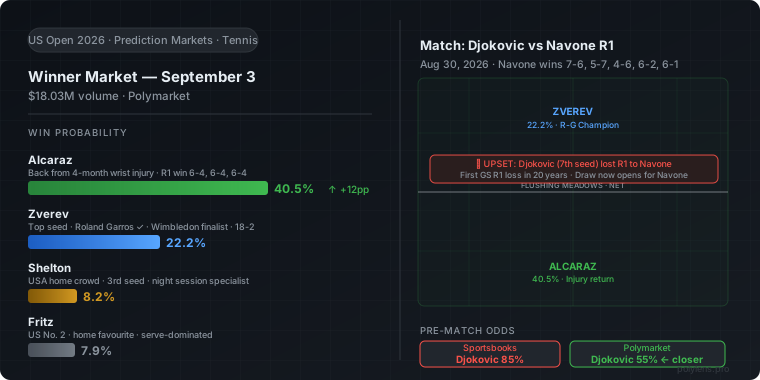
When the Djokovic–Navone match draw was announced for August 30, Polymarket's individual match market opened with Djokovic at approximately 55 cents — implying a 55% probability of a straight or four-set win. I remember looking at this and thinking it was unusually low for Djokovic in a grand slam opener. The reference point is conventional sportsbooks, which had him at roughly -600 in some markets — 85% implied probability. That is a 30-point gap on the same binary outcome.
Navone won in five sets. Djokovic was visibly ill, wore down over four hours and 36 minutes, and dropped the last two sets convincingly. The Polymarket crowd was 30 points closer to the right answer than the traditional bookmakers. That deserves more attention than it's getting — particularly now, with $18 million riding on who wins the tournament in 10 days. If Polymarket's per-match calibration was better than sportsbooks on Djokovic–Navone, the question is whether it's also better on the winner market currently showing Alcaraz at 40.5% and Zverev at 22.2%.
Djokovic at 55%: Why Polymarket Was Right and Sportsbooks Were Wrong
The 55% vs 85% gap on the Djokovic match was not random noise. It reflected a genuine difference in how the two types of markets process soft information. Traditional sportsbooks priced Djokovic's R1 match primarily on his historical head-to-head record with Navone (dominant), his ranking (much higher), and his long-run grand slam R1 record (zero losses since 2006, 78 consecutive wins). The algorithm overweighted historical data and underweighted current signals.
Polymarket traders had additional context in circulation: Djokovic had been less visible in training before the tournament, there were whispers about physical condition, and crucially — Navone's hard-court form in late July and August had been quietly excellent. Polymarket markets aggregate this kind of diffuse, non-quantifiable signal better than bookmaker models, which are anchored to database statistics. This is the theoretical reason Polymarket should outperform books on events with significant soft information — and the Djokovic upset was exactly that type of event.
The consequences of the upset have been substantial. Djokovic was the 7th seed (seedings adjusted down after Sinner's withdrawal). He occupied the same half of the draw as Alcaraz. With Djokovic gone, Alcaraz's projected QF opponent is now Navone — a 25-year-old Argentine ranked outside the top 40 who is playing the biggest matches of his career. The path clearance is worth roughly 8–12 percentage points of probability in a typical tournament winner market, and Polymarket priced almost exactly that: Alcaraz moved from ~28% pre-tournament to 40.5% after his R1 win, a 12.5-point jump in 24 hours.
| Platform / Market | Djokovic Win Prob. | Navone Win Prob. | Actual Result |
|---|---|---|---|
| Sportsbooks (consensus) | ~85% | ~15% | Navone ✓ |
| Polymarket (match market) | ~55% | ~45% | Navone ✓ |
| Kalshi (match market) | ~60% | ~40% | Navone ✓ |
| Expected probability (naive) | ~90%+ | <10% | Navone ✓ |
Three prediction markets — Polymarket, Kalshi, and the combined sportsbook consensus — all disagreed significantly on this match. Polymarket and Kalshi were close to each other (55% and 60% respectively for Djokovic) and both gave Navone a real chance. Sportsbooks were at 85%. The actual margin of Navone's win — 7-6, 5-7, 4-6, 6-2, 6-1 — suggests the match was genuinely competitive in the first three sets and then swung sharply once Djokovic's energy ran out. A 45% probability for Navone capturing this match does not look like an overestimate in hindsight.
Djokovic's loss ended a streak that seemed permanent: 78 consecutive R1 wins at grand slams, no opening-round defeat since 2006, twenty years of first-round dominance that had become structural background noise in professional tennis. He will also drop out of the ATP Top 10 as a result — the first time since July 2018, an eight-year streak also ending. The broader questions about the end of the Djokovic era, raised across tennis media, are legitimate but outside the scope of a Polymarket analysis. What matters here is that the $18M market is now operating with a much cleaner draw.
Alcaraz at 40.5%: Is a Defending Champion Worth This Much After Four Months Out?
Carlos Alcaraz is the defending US Open champion. He is also making his first tournament appearance after a right wrist injury kept him out for more than four months. Those two facts are in direct tension, and the Polymarket crowd has resolved them by pricing him at 40.5% — the highest individual probability in the winner market by a margin of 18 percentage points over Zverev.
The pre-tournament price was approximately 28%. This is the baseline from which to measure the post-R1 repricing. Sportsbooks had Alcaraz at +250 before the tournament — which implies a 28.6% win probability. Polymarket and traditional markets were almost perfectly aligned on Alcaraz before play began. That alignment is itself noteworthy: it means the injury discount was being applied consistently across market types, and there was no significant divergence to exploit.
After his R1 win over Safiullin — 6-4, 6-4, 6-4, convincing and straight sets — the market repriced 12.5 points upward to 40.5%. That repricing had two drivers: the match result itself (confirming his wrist is functional at match pace) and the Djokovic elimination from the same half of the draw. You cannot easily separate these two signals in the odds movement, but the combined effect is substantial. The market is saying: Alcaraz is back, his wrist held up, and his projected path to the final just became significantly easier.
The calibration question is harder. 40.5% for a player returning from four months of injury, who has played exactly one match of tournament tennis since early June, against an opponent who has won two grand slams and is currently ranked in the top-5 — is that right? The historical base rate for players returning from extended injury absences to win a major is not encouraging. Andre Agassi, Roger Federer, and Rafael Nadal all had documented cases where extended absences were followed by early exits rather than titles, even at tournaments they dominated historically.
The counter-argument is that Alcaraz is 23, his injury was to a specific anatomical structure (wrist ligament) rather than a systemic issue, and his pre-injury form in 2025 was elite. His first round at 6-4, 6-4, 6-4 in straight sets suggests no movement restrictions, no hesitation on his signature heavy-topspin forehand. Whether the wrist holds through five sets in the heat of Flushing Meadows over 10 days of tournament tennis is the unknown that 40.5% is pricing. It is not a certainty — it is a probability, and the market is saying it's the highest in the field.
Zverev at 22.2% — 18-2 at Grand Slams and Still at a Discount to Alcaraz
This is the number I keep returning to. Alexander Zverev has gone 18-2 at grand slam tournaments in 2026. He won Roland Garros in June — the first German man to win in Paris since 1937, defeating Flavio Cobolli 6-1, 4-6, 6-4, 6-7, 6-1 in the final. He reached the Wimbledon final in July — falling short of the Channel Slam but demonstrating sustained form across clay and grass that few players in the Open Era have matched in a single calendar year. He is the top seed at Flushing Meadows, his two losses at majors this year were in finals and semi-finals, not early rounds.
And yet: 22.2%. Nearly half of Alcaraz's 40.5%.
The 18-point gap between Alcaraz and Zverev reflects several things simultaneously. First, there is the name and narrative premium — Alcaraz is the defending US Open champion and carries a higher recognition value for casual bettors who participate in large-volume markets. Second, Alcaraz's 40.5% was partly driven by the Djokovic elimination, which opened his half of the draw. Third, US Open hard courts have historically favored Alcaraz's style — his high-bouncing forehand and aggressive baseline positioning suit the surface better than they suit Roland Garros clay, where Zverev defeated him.
The sportsbook comparison is revealing. Before the tournament, sportsbooks had Zverev at +300 (25% implied) versus Polymarket's 21%. That 4-point gap — Polymarket pricing Zverev lower than implied by money-line odds — is unusual. Typically Polymarket and sportsbooks agree within 2–3 points on major tennis favorites. The discrepancy suggests Polymarket's user base applies a discount to Zverev that books do not, possibly reflecting the persistent narrative that Zverev "can't win on hard courts" despite his 18-2 2026 record suggesting this concern is outdated.
| Player | Polymarket (Sep 3) | Sportsbooks (pre-tourn.) | Poly vs Books | 2026 Slam Record |
|---|---|---|---|---|
| Carlos Alcaraz | 40.5% | 28.6% (+250) | +12pp (post-R1) | 1-3 (injury WDs) |
| Alexander Zverev | 22.2% | 25.0% (+300) | −2.8pp | 18-2 (RG ✓ W2) |
| Ben Shelton | 8.2% | 7.1% (+1300) | +1.1pp | Not specified |
| Taylor Fritz | 7.9% | ~8% est. | ~0pp | Not specified |
| F. Auger-Aliassime | ~6–8% est. | +800 (11.1%) | Mixed | 3rd seed |
The statistical argument for Zverev being underpriced is real. His 2026 grand slam record is objectively better than anyone else in the field, including Alcaraz whose injury absences mean he has played fewer matches at a lower baseline of match fitness. A tournament winner market should weight recent form heavily, and Zverev's form curve is pointing decisively upward: Roland Garros → Wimbledon final → top seed at US Open. The crowd has him at 22.2%. The math suggests he might belong in the low 30s.
The counterargument: US Open is the one major Zverev has never won or reached the final of prior to 2026. His historical hard-court results at Flushing Meadows include quarter-final exits and semi-final losses. The hard court conditions at the US Open — fast, bouncy, favouring big servers and aggressive baseliners — do not obviously suit his patient clay-court baseline game. But then again: his Roland Garros win this year was supposed to be impossible for his style, and he won in four sets.
The Open Quarter: Navone, Medvedev, and the Half Without Djokovic
Djokovic was seeded seventh, placing him in the same quarter of the draw as Alcaraz (second seed). The projected quarter-final before the tournament was Alcaraz vs Djokovic — a match-up that would have been worth watching regardless of form, given their history. That match will not happen. Instead, the Alcaraz quarter now features Navone as potentially the most dangerous opponent on that side of the bracket.
Navone — 25 years old, ranked outside the top 40 before this tournament, Argentine — has now beaten Djokovic at a grand slam. That is a biographical fact that changes how opponents approach him. His game is not Djokovic-beating by design: he is a solid baseliner with good defensive footwork and exceptional stamina (evidenced by winning a 4h36m five-set match while his opponent was ill). Against Alcaraz, who is still building match fitness after 94 days off the tour, Navone's stamina advantage could be relevant in the later sets of a long match.
On the other side of the draw — Zverev's half — the picture post-Djokovic is less disrupted. Zverev was in the opposite half from Djokovic, meaning the upset did not directly change Zverev's projected path. His potential quarter-final opponent remains either de Minaur or Auger-Aliassime, depending on seedings. Medvedev, if he advances, is on Zverev's side as well. The Zverev half is arguably harder in structure — de Minaur and FAA are both reliable hard-court performers who have beaten top-10 players in 2026 — while Alcaraz's half became cleaner the moment Navone won.
Shelton at 8.2% and Fritz at 7.9%: The American Night Session Factor
No sports venue in the world applies more consistent home advantage to tennis than Flushing Meadows at night. The Arthur Ashe Stadium crowd — loud, partisan, hostile to visiting players — has historically contributed meaningful support to American players in the late rounds. Ben Shelton and Taylor Fritz are the two Americans with realistic paths deep into the tournament, and their combined 16.1% on Polymarket reflects genuine market belief that one of them could go the distance.
Shelton at 8.2% is higher than his pre-tournament figure on Polymarket (5.5%) and higher than his sportsbook implied odds of 7.1% (+1300). The upgrade reflects his R1 progress and the recognition that his serve — among the most powerful on tour — is a genuine equalizer on US Open hard courts. Shelton is 24, reaching the upper bound of age where ATP serve-and-forehand players typically peak, and his 2026 record coming into the tournament was solid on hard courts. The crowd factor at night sessions in the later rounds is worth at least 2–3 percentage points, and the market appears to be applying it.
Fritz at 7.9% is slightly more surprising given that his 2026 record entering the tournament was less dominant than Shelton's. Fritz is a US Open specialist — he has reached the semi-finals here previously — and his serve-and-return game suits the conditions. The 7.9% likely reflects a combined baseline probability (his draw position, seeding, form) plus an American premium. Whether that premium is rational or sentimental is impossible to determine from the odds alone — but it is consistent with how prediction market crowds treat home-nation players at major events. Our sports markets guide covers the documented home-nation premium in Polymarket's tennis markets in more detail.
The 10-Day Market: How Polymarket's US Open Odds Will Move From Here
The winner market will reprice at specific moments over the next 10 days. Round 2 concludes around September 4–5. Round 3 (third week) follows immediately. The quarters are September 9–10, semis September 11–12, and the final September 13. Each result from the top 8 players generates a discrete odds jump — or collapse. Alcaraz losing to Navone would send his 40.5% to zero and redistribute most of it to Zverev and possibly Shelton. Zverev losing to de Minaur would send his 22.2% to zero and make Alcaraz a 60%+ favourite.
The volume pattern in these markets is instructive. The $18.03M currently on the winner market has been accumulating since before the tournament started — the market has been live since the draw. In the past three days (since R1 played out), approximately $1.2–1.5M per day has traded, with the largest single-day volume on August 30 when Djokovic's loss created a sudden, large repricing event. These spikes are the most predictable volume moments and also the moments when the PolyLens signals feed tends to fire, because large wallets position before and after the news rather than at the exact moment of the odds move.
The tracker metric I follow most closely in these tennis markets is the ratio of smart-money positions — wallets with positive PnL on the platform tracked via PolyLens leaderboard — to total volume. When the top-PnL wallets are disproportionately on one side of a market, their historical win rate is measurably higher than the field. The Australian Open 2026 data showed three top-PnL wallets accumulated Sinner positions between 20% and 26% odds before he won. The US Open winner market currently shows $1.67M in open interest — the question is whether that open interest is concentrated in Alcaraz (consistent with the crowd) or leaning toward a contrarian position on Zverev.
Polymarket vs Sportsbooks on Tennis: Where the Divergence Is Tradeable
The Djokovic match result demonstrated one specific type of Polymarket edge on tennis: per-match binary outcomes where soft information about player condition matters more than historical statistics. Polymarket's crowd of crypto-native, information-aggregating bettors tends to price these situations more accurately than algorithmic bookmaker models. This is not a universal advantage — on straightforward, data-heavy outcomes (who wins French Open clay on clay when all players are healthy?), the divergence between platforms is minimal.
The US Open winner market is somewhere in between. It has soft-information components (Alcaraz's injury recovery status, Djokovic's health before R1, Navone's form) and hard-information components (seedings, historical records, draw position). OddsShopper's pre-tournament analysis noted that Polymarket and Kalshi split on several US Open prices — Kalshi had Alcaraz at 25 cents (vs Polymarket's 28 cents pre-tournament) and Zverev at slightly different levels. These were small gaps before play started. Post-R1, with Djokovic gone and Alcaraz repriced to 40.5%, the gaps will need to re-establish.
The arb-adjacent opportunity in tennis prediction markets comes from the lag between on-court events and odds updates. When Djokovic lost at 5:30 AM local time on August 30, the match market resolved correctly — but the winner market took approximately 40–60 minutes to fully reprice Alcaraz from 28% to the 35–38% range, and then continued drifting upward to 40.5% over the following 24 hours. Traders who were watching the match in real time had a meaningful window to position in the winner market before the odds caught up. This is a structural feature of Polymarket's tournament markets that the signals feed is specifically designed to catch.
Ten days until the men's final. Alcaraz at 40.5%, Zverev at 22.2%, with $18 million already traded and the market repricing every time someone holds a serve in the fourth set. The Djokovic upset proved that Polymarket's crowd reads soft signals more accurately than bookmakers on individual match outcomes. Whether that accuracy extends to the full 128-player tournament winner question — across 10 days and seven rounds — is what the next week will resolve.
- Polymarket Sports Markets Guide: Where Edge Hides in Tournament, NFL, and Champions League Markets
- Spain at 59%: How Polymarket Called the 2026 World Cup — $4.3B Accuracy Breakdown
- CLARITY Act 13% + Fed Hike 46% — Polymarket's September 15–16 Risk Map
- $20M on Bitcoin's August — Polymarket Odds Hit 85% on $80K
- How to Track Whale Wallets on Polymarket and What Their Positions Signal
- One Polymarket Trader Lost $11.6M in 10 Days on the World Cup — We Analyzed Every Trade